


by Wellton Máximo
Meta, which runs Instagram, Facebook and Threads, must take down posts that encourage business owners to persecute, expose or fire employees over their political preferences, a labor court has ruled.
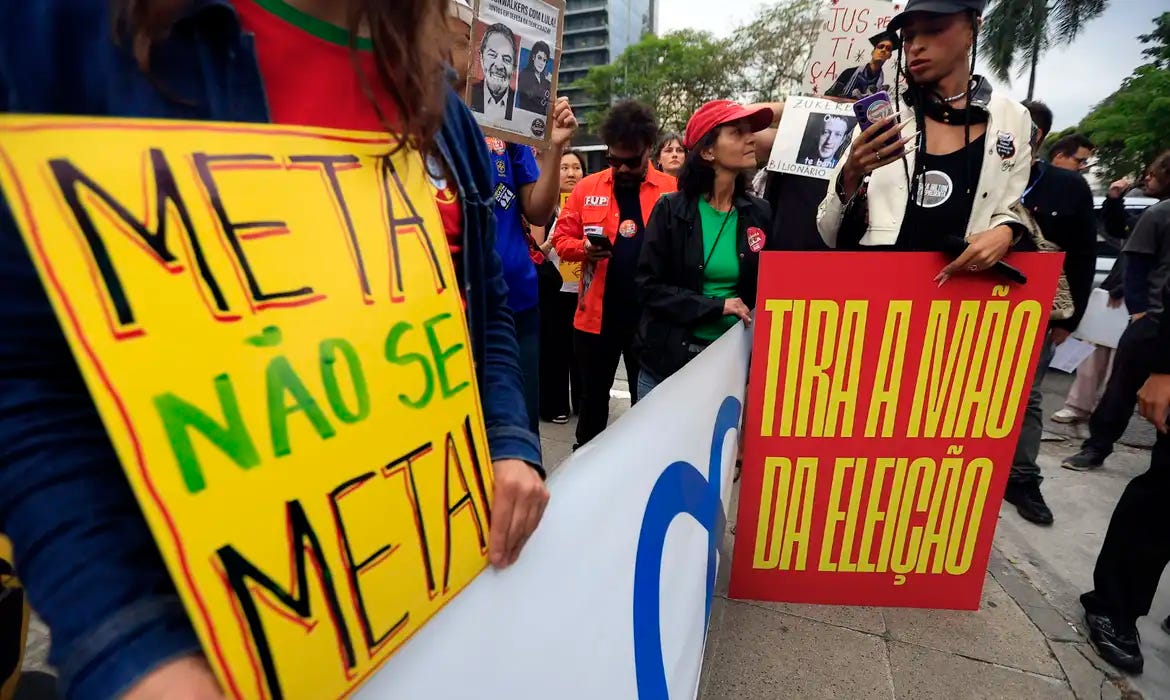
Protest in front of Meta headquarters in S. Paulo (photo: Paulo Pinto/Agencia Brasil)
Judge Bruno José Perusso of São Paulo’s 77th Labor Court granted the preliminary injunction on Thursday. It came in a public civil action filed by the Public Labor Prosecutor’s Office (MPT).
MPT is also seeking R$50 million (about $9.2 million) in collective moral damages. Meta has 24 hours from being notified to remove 14 posts that MPT identified.
The decision also orders Meta to suspend the algorithmic recommendation of those posts. Meta must also show users of all three platforms in Brazil a warning about electoral harassment.
Electoral harassment
MPT says it brought the action after receiving more than 3,080 complaints of electoral harassment across Brazil during the 2026 election. Of those, 1,147 were filed within 72 hours after the runoff.
MPT says social media posts encouraged employers to:
investigate employees’ profiles to find their political preferences;
monitor how workers vote;
stop hiring people because of their political convictions;
fire employees who backed candidates other than the ones their bosses preferred; and
expose workers to public ridicule for their electoral choices.
MPT also says the platforms’ recommendation systems, such as Instagram’s Explore tab and suggested Reels (short videos), could widen the reach of this kind of content.
Meta’s obligations
The decision sets out several measures Meta must carry out:
Removal: delete the 14 posts MPT identified within 24 hours of being notified;
Recommendations: stop the algorithmic boosting of the identified content;
Notification: tell the owners of the affected accounts within 48 hours that the posts were removed under a court order;
Preservation of evidence: keep the removed material and its technical records until the case ends; and
Warning to users: publish an institutional notice on all three platforms within 72 hours, to stay up for five consecutive days.
The notice must state that Brazilian law bans discrimination against workers over their political convictions, preferences or expression. The ban applies to hiring and firing decisions as well.
Freedom of expression
In the decision, Perusso wrote that freedom of expression and the voicing of political opinions are protected rights. He also wrote that these rights do not allow anyone to encourage discriminatory practices in labor relations.
Perusso distinguished between voicing partisan opinions and inciting professional persecution of workers over their electoral choices. He added that the ability to fire without cause does not let employers use an employee’s political preference as grounds for discriminatory punishment.
Fines and damages
If Meta fails to comply with the removal order, it could face a daily fine of R$50,000 (about $9,200) for each post left online. Failing to publish the institutional notice could bring a fine of R$200,000 (about $36,800).
The injunction is provisional and is not a final ruling on the case. The court has yet to decide on the R$50 million request for collective moral damages. The case is pending in the 77th Labor Court of São Paulo. Meta can appeal the decision in the labor court system.
This article first appeared in Agência Brasil, a nationwide public news agency, run by the Brazilian government. and has been translated by Panamerican Dispatch. Read it in its original Portuguese here.