


by Jorge Abreu
On Thursday, October 22, the 5th Federal Court of Pará ordered the federal government to implement, within 24 hours, the administrative, operational, logistical, and financial measures to ensure air, river, or land transportation for Indigenous people across the country to cast their votes in the second round of elections this Sunday.
The ruling responded to a request from the Federal Public Prosecutor’s Office. The order also mandated that the government provide food, support for municipal governments, the presence of interpreters, and signage in Indigenous languages at polling stations.
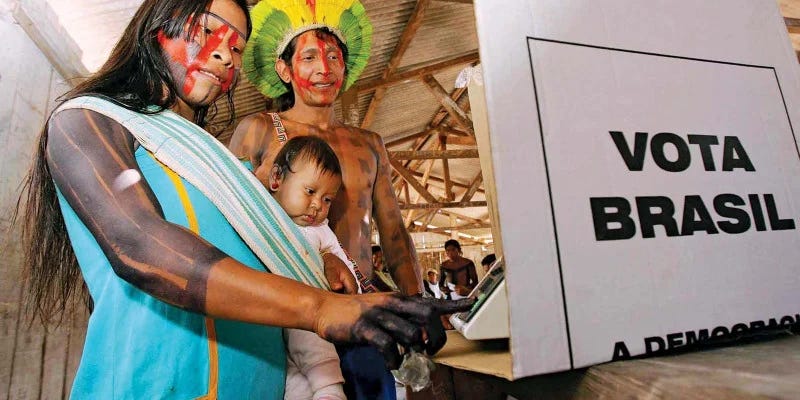
The courts have ordered the government to ensure transportation for Indigenous people for the second round of elections. (Articulation of Indigenous Peoples of Brazil / Apib)
The Office of the Attorney General stated that it is already in discussions with the Prosecutor’s Office to comply with the decision. Under the terms of the civil lawsuit, the government could face a fine of $250,000 if it fails to comply.
During the first round, entire communities faced difficulties reaching polling stations, particularly in the Amazon, due to a lack of transportation, fuel, food, and logistical support, as well as a shortage of translators for native languages.
The Araweté, Arara, Parakanã, Xikrin, and Munduruku ethnic groups are cited in the lawsuit as some of the most affected communities in the state of Pará. Similar challenges also hindered other Indigenous peoples across Brazil. Indigenous leaders from the states of Minas Gerais, Mato Grosso, Amapá, Pernambuco, and Amazonas have also reported that members of their villages were unable to vote on October 4 due to these barriers.
Court orders Federal Government to ensure transportation for Indigenous people for the second round of elections. (Apib / Archive)
“The peoples of the Amazon face great difficulties due to the distances involved, whether traveling by river or by road,” said Alessandra Korap Munduruku, an Indigenous leader from the Middle Tapajós, a region located in the southwest of Pará state.
“By road, it often takes three or four hours just to reach the point where one can board a boat, which then takes another two to four days to reach the polling stations. These peoples must be able to exercise their right to vote. That is guaranteed by the Constitution,” she added.
In the state of Amazonas, the Regional Electoral Court initially denied a request from Univaja, the Union of Indigenous Peoples of the Javari Valley, to provide free river transport for the second round of the elections to Indigenous people from 43 villages within the Indigenous territory located at the tri-border area between Brazil, Peru, and Colombia.
Following a protest by Univaja, joined by other Indigenous organizations, the Amazonas Regional Electoral Court reversed its decision and announced that it would provide transport for voters in the Javari Valley, one of the most difficult-to-access areas in Brazil.
On October 9, Federal Deputies Sonia Guajajara (PSOL-SP) and Célia Xakriabá (PSOL-MG) sent an official letter to the Superior Electoral Court demanding measures to ensure that Indigenous people could cast their votes in the second round of the elections.
According to the document, in the Amazonas municipality of Lábrea, nearly 7,000 people were unable to reach the polls due to a lack of transportation. Official election data confirms 6,888 abstentions in the municipality, equivalent to 23.47% of the 29,351 eligible voters. Other municipalities with significant Indigenous populations, such as São Gabriel da Cachoeira (Amazonas) and Jacareacanga (Pará), saw abstention rates of approximately 25.7%, higher than the national abstention rate of 21.6%.
In the state of Amazonas, the rate was 20.1%, and in Pará, it was 19.1%.
Members of the Tiriyó and Kaxuyana peoples in Amapá reported being unable to vote because they could not understand the instructions provided by poll workers, as they are not fluent in Portuguese. They stated that they were told the Superior Electoral Court did not authorize the use of interpreters at polling stations.
Although contacted by reporters as early as October 13, the electoral court has not responded regarding what measures it intends to take to minimize the problems reported by Indigenous individuals.
This article was originally published at ICL Noticias. It was translated with permission by Panamerican Dispatch. You can read the original, in Portuguese, here.