


by Jamil Chade
The Brazilian government is seeking to lift the debate over foreign intervention through social media to the international stage. It comes less than a week after the Brazilian election, which was impacted by the role of digital platforms and accusations of U.S. involvement.
In a document obtained by ICL Notícias, Brazilian diplomats requested that the leadership of the Organization of American States, OAS, include the issue of foreign intervention through manipulated information in the organization’s meeting on November 4, in Washington. The proposal was received favorably by the governments of Mexico, Uruguay, and Canada.
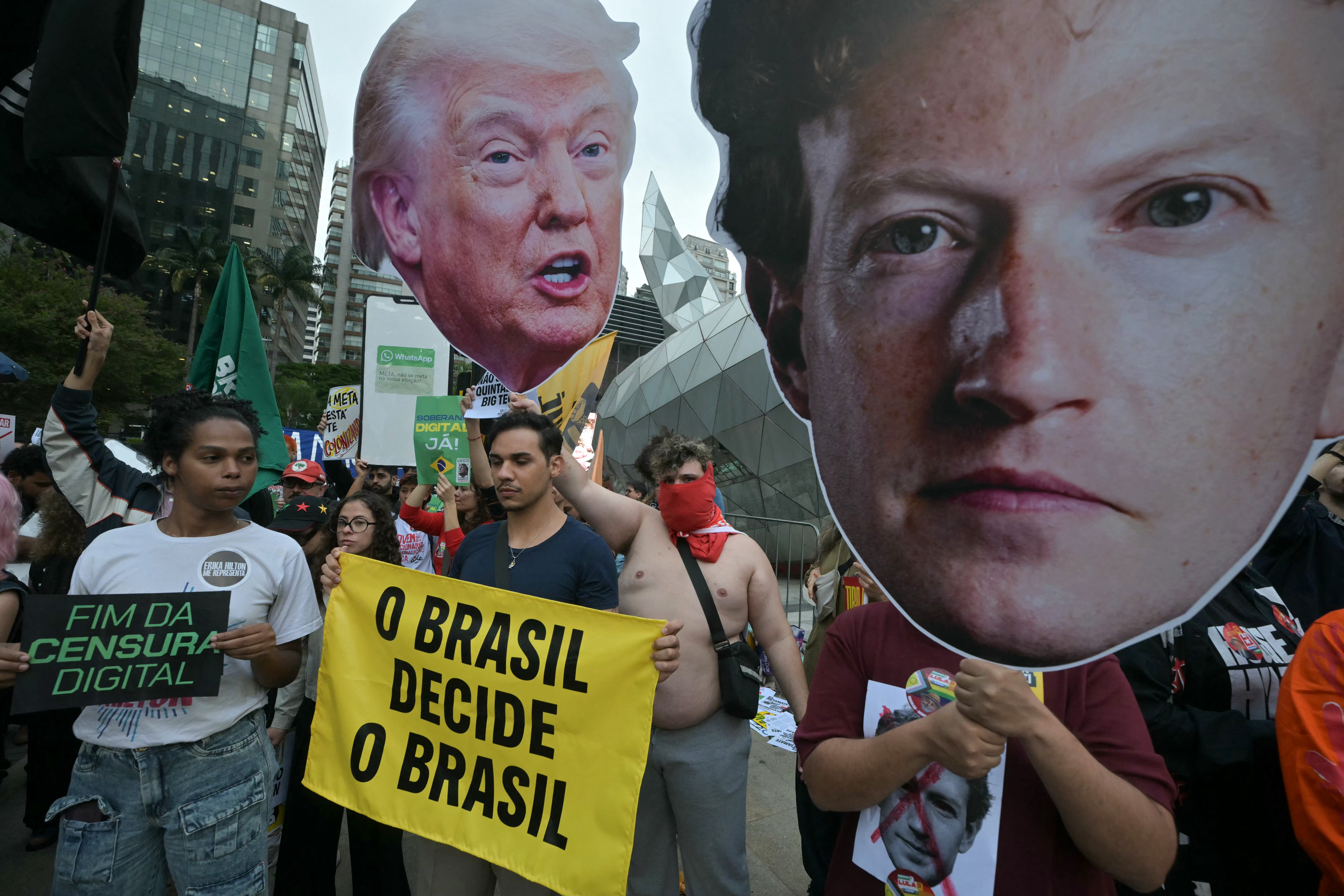
Brazilians hold signs reading “Brazil Decides Brazil”, “End Digital Censorship” and carry oversized cutouts depicting Meta CEO Mark Zuckerberg and U.S. President Donald Trump during a demonstration in front of Meta’s headquarters in São Paulo, Brazil, on October 19, 2026, denouncing alleged interference by big tech companies in the Brazilian election. (Photo by NELSON ALMEIDA / AFP via Getty Images)
In presenting the rationale for including the issue on the OAS agenda, the Brazilian document highlights how “foreign interference and manipulation in the information space pose a challenge to the free formation of political will, the integrity of public debate, and the functioning of democratic institutions.”
“Operations of this nature can compromise electoral processes, deepen social divisions, and weaken trust in institutions and the press,” it warns. “Their cross-border reach and the use of digital technologies make a multilateral discussion advisable, one focused on responses consistent with democracy, human rights, and state sovereignty.”
The idea is for the OAS to conduct an initial technical review to “determine conceptual convergences, assess the adequacy of existing standards, and identify potential gaps.”
“It would also be possible to analyze criteria for potential forms of cooperation, as well as parameters for transparency and accountability on the part of digital actors, without prejudging the form or content of any future decisions that states might take in this regard,” the document explains.
Brazil noted that the issue of foreign interference in elections is part of the broader subject of foreign intervention and manipulation in the information space, a topic that has been addressed with increasing frequency within multilateral forums.
“The focus has been on defending the right to freedom of expression and the integrity of information, based on the premise that disinformation and ‘fake news’ have had negative effects on the conduct of free and fair elections, irreparably damaging the democratic processes through which the popular will is formed,” the document states
In defining the concept, Brazil highlighted how it encompassed manipulative, intentional, and coordinated behaviors carried out by foreign actors, whether state or non-state, either directly or through intermediaries.
Among the techniques employed are the concealment of the origin and funding of campaigns, the use of networks of fake accounts, the impersonation of media outlets, and the artificial amplification of content, including through the use of artificial intelligence.
“The analysis focuses on the methods employed, the coordination, and the foreign connection of the operation, rather than solely on the veracity of individual messages,” the document notes.
Brazil pointed out that the debate is already well-advanced in Europe and within the UN.
“A discussion within the Permanent Council [of the OAS] would allow for an examination of how these principles apply to contemporary information manipulation operations, and what cooperative measures could strengthen national capacities, all while ensuring compliance with applicable international obligations and Inter-American human rights standards, including the requirements of legality, necessity, proportionality, and due process,” the Brazilian Foreign Ministry argued.
This article was originally published by ICL Noticias. It was translated by Panamerican Dispatch. You can read the original, in Portuguese, here.