


By Reynaldo Aragon
I started writing about the repositioning of U.S. military forces in Latin America and what it meant for Brazil in November, 2025. This October I was even more explicit: the military encirclement of our country was already a strategic reality. In my book O Cerco (The Encirclement), I presented part of my research into this buildup, tracing the military, economic and diplomatic pressure Washington had been building. None of it was guesswork. The documents, agreements and decisions were public. What was needed was to see how they connected, whose interests they served and where they were heading.
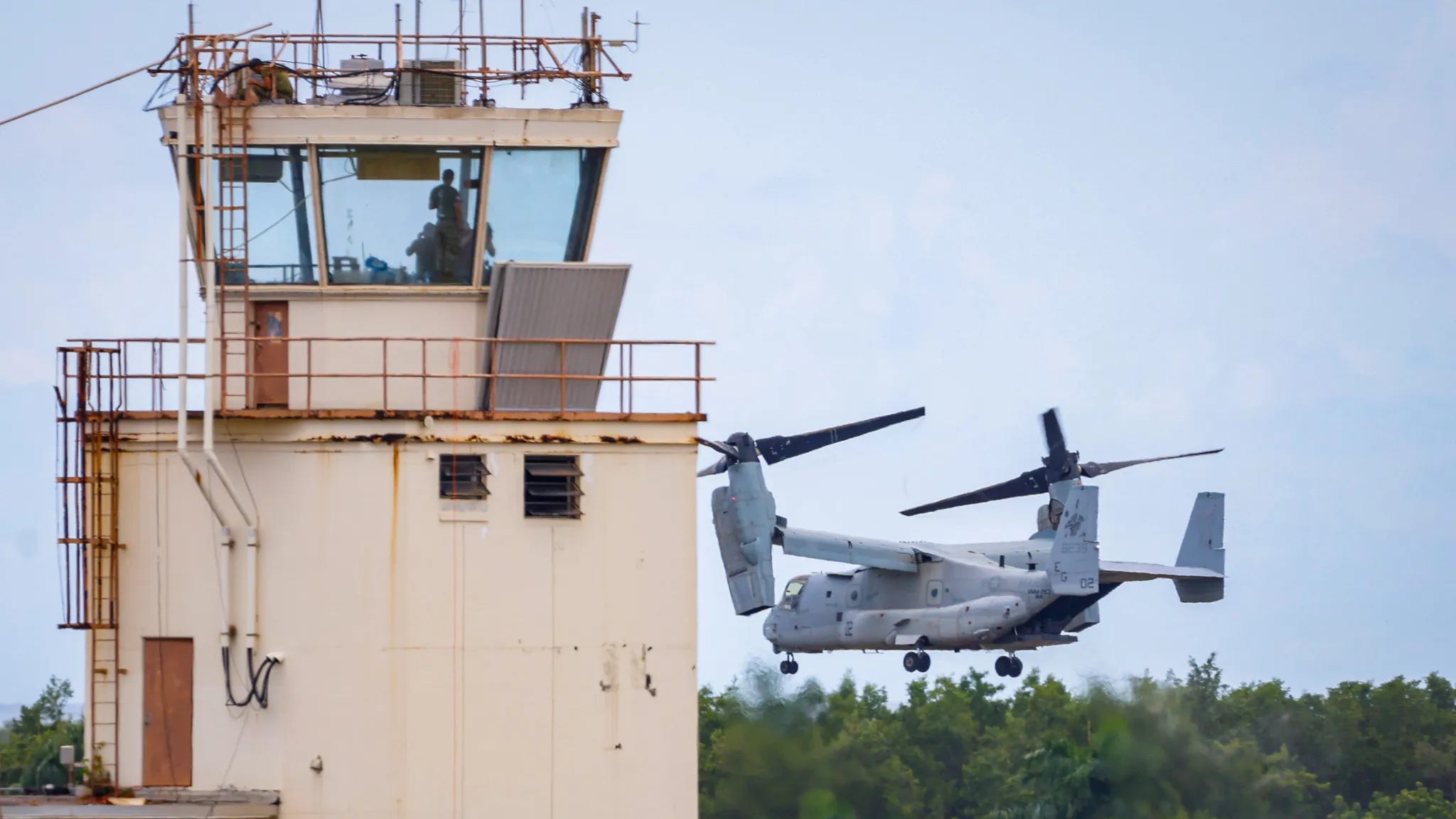
A US V-22 Osprey takes off from Roosevelt Roads naval base in Puerto Rico. (Photo: Kendall Torres Cortés/Getty Images
On Nov. 20, 2026, Washington’s strategy gained formal backing from the Organization of American States. By a vote of 14 to 2, with Brazil and Uruguay opposed, the OAS agreed to call a meeting of the countries that signed the Inter-American Treaty of Reciprocal Assistance, known as the Rio Treaty, a 1947 pact on collective defense. Twelve governments, including the United States, proposed the meeting. Their proposal frames drug trafficking and terrorism as possible threats to peace in the hemisphere. The resolution did not authorize armed force, but it opened the door to discussing collective measures under a treaty written for hemispheric defense.
What makes this serious is the change in how the problem is framed. Fighting organized crime calls for cooperation among police, financial regulators and courts. Now the issue is being handled inside a collective security system in which Washington holds overwhelming power over every other country in the Americas. The precedent widens the room for coercion over sovereign decisions, and it fits into a military reorganization already under way across the continent. What I have documented for years now has formal confirmation that Brazil cannot afford to ignore.
The Rio Treaty’s mechanics deserve a close look. Article 6 lets member countries meet and decide on joint measures whenever a situation threatens the peace of the Americas, even in the absence of any type of armed attack. Article 8 lists what those measures can include, from cutting diplomatic ties to partly or fully halting economic relations and sea and air links. Under Article 20, such decisions bind the countries that ratified the treaty, though no country can be required to use armed force without its consent. The November resolution applied none of these measures. It only opened the process in which they could be debated. That distinction matters, but it does not make the precedent harmless.The question is who gets to decide what counts as a threat, and what powers come with that decision. By tying drug trafficking and terrorism to collective defense, the coalition Washington has assembled moves the debate to ground where the gap in power among the countries of the Americas decides the outcome. Nobody has to fire a shot to disrupt trade, transportation and diplomatic relations. The measures only have to be approved. The treaty supplies the tools, and the balance of power will determine how they are used.
Brazil had offered another path. In an official note sent to the OAS before the vote, it called for tracing money and weapons, fighting money laundering, recovering assets and expanding police and judicial cooperation, all with respect for each state’s sovereignty. The choice is not between fighting crime and protecting sovereignty. The point is to keep the fight against crime from becoming a blanket license to concentrate power over other countries. That danger comes into sharper focus when we turn from treaties to the U.S. military presence on the continent.
If the goal is really to fight drug trafficking, why don’t these governments put Brazil’s proposal at the center of the talks? Why push militarization when they could follow the money, identify the financiers and dismantle the networks that keep crime going? Who benefits from moving the fight onto military ground? And above all, who benefits when drug money is left out of the investigation?
To see whose interests are at stake, start with the Pentagon’s own documents. In January 2026, the U.S. National Defense Strategy set three goals for the hemisphere: restore American military dominance, secure access to strategic geographic positions and keep rival powers from building up capabilities in the region. It also provides for unilateral action against groups it labels narcoterrorists. This is the Monroe Doctrine updated and written into military policy. Washington is declaring that it intends to secure, by force if necessary, the primacy it believes it needs to defend its interests.
The deployments match the strategy. In March, Gen. Francis Donovan, commander of U.S. Southern Command, told Congress that the United States had widened its access to strategic facilities in Panama, with rotating troop deployments at Panamá Pacífico, Noel Rodríguez and Cristóbal Colón. At Cristóbal Colón, construction is under way on infrastructure to support operations and jungle training. Guantánamo remains a base for projecting force in the Caribbean. Soto Cano, in Honduras, keeps a regional response capability, while Comalapa, in El Salvador, eases the movement of forces. Together these sites form a network able to move personnel, equipment and intelligence across the continent.
The push also extends to South American countries around Brazil. In March, Paraguay passed Law 7,630, which sets legal conditions for the temporary presence of U.S. Defense Department troops, civilian officials and contractors. In October, Guyana signed a military cooperation declaration with Washington that calls for training across several domains, joint exercises and expanded air surveillance. In Ecuador, U.S. forces have taken part in joint operations against groups labeled terrorists since March. Each agreement has its own terms, but all of them widen U.S. military access and room to operate in the region.
These facts do not point to an order to invade Brazil. They do point to something that deserves immediate attention. The United States is strengthening a regional network for projecting military power, while its official doctrine allows unilateral action and aims to keep rivals from gaining a strategic foothold. Neighboring countries do not become Brazil’s enemies by cooperating with Washington. The problem is a concentration of capabilities that could tilt the balance of power and limit national autonomy. That is what I mean by the encirclement of Brazil. Its military side is documented. What remains is to understand the economic interest behind this reorganization.
The economic side is spelled out in the National Security Strategy the White House published in December 2025. Washington argues that its dominance in the hemisphere depends on keeping rival powers from controlling ports, infrastructure and strategic assets in the region. The document says alliances and aid programs should depend on reducing that influence, and it calls for financial and technological tools to pressure governments into turning down certain partnerships. In September 2026, the U.S. led Shield of the Americas alliance added controls on investment, critical mineral supply chains and digital infrastructure suppliers. U.S. policy now openly treats other countries’ economic decisions as matters of its own national security.
Brazil sits at the center of this contest. According to the National Bank for Economic and Social Development (BNDES), Brazilian exports to China reached $58.3 billion in the first half of 2026, up 21.9% from the same period in 2025. Sales to the United States came to $17.4 billion, down 13%. The difference points to a structural shift in Brazil’s economic relationships. China has become the main destination for Brazilian exports, while Washington tries to regain a continental influence it can no longer wield through traditional means alone. This is not about trading one dependence for another. Brazil’s interest lies in keeping the ability to deal with many partners, build its industry and decide for itself how to use its own wealth.
The contest extends to the geography of trade itself. In July 2025, Brazil and China signed a memorandum to study a rail link between the Atlantic and Pacific coasts, ending at the Peruvian port of Chancay, a link that could widen Brazil’s access to Asian markets. In September 2026, the United States and Argentina announced the Andes Atlantic Corridor, a plan for transportation, energy and technology infrastructure with U.S. financing and priority on exporting strategic resources. The two projects are at different stages, but both show the competition over how South America’s supply chains and trade routes will be organized.
This is where military presence, diplomatic pressure and economic tools serve a common interest. Whoever can set conditions on ports, financing, technology and trade corridors can steer a country’s choices without occupying its territory. For a power determined to keep its global primacy as China rises, Brazilian autonomy is a strategic problem. For Brazil, what is at stake is the right to set its own economic relationships, industrialize its resources and help reshape global trade without accepting foreign control. Seen through this conflict of interests, the Lula government’s stance takes on its true weight.
Lula’s reelection on Oct. 25 showed that millions of Brazilians chose to preserve a political project that refuses to bow automatically to Washington’s interests. But winning an election does not neutralize outside pressure. Brazil’s government faces a power that openly states its intention to regain primacy in the hemisphere and has the military, financial, technological and diplomatic means to pursue it. Brazil’s stance at the OAS has to be read in that light. It was not a procedural disagreement. It was a defense of a principle essential to our existence as a sovereign nation.
The risk now is that these tools combine into an escalation against Brazil’s autonomy. Economic sanctions, trade restrictions, pressure on investment, wider military access in neighboring countries and operations justified by the fight against narcoterrorism should each be watched as a separate possibility with its own consequences. None of them justifies saying an invasion has been decided. But ignoring the coercive power already in place would be a strategic mistake. Brazil needs to strengthen its intelligence services, protect critical infrastructure, build its own technological and military capabilities, deepen South American integration and make sure security agreements do not cost it control over information, operations and decisions.
This responsibility goes beyond the Lula government. It falls on the armed forces, Congress, Brazil’s institutions, workers and every sector committed to national development. Sovereignty cannot rest on diplomatic speeches alone. It depends on productive capacity, technological independence, financial autonomy and the political strength to resist outside pressure. A country that does not control the material conditions of its choices can keep its formal institutions and slowly lose the freedom to decide.
I keep sounding this alarm because the consequences will not stop at Brazil’s borders. At stake is whether the peoples of Latin America can set their own economic, political and strategic relationships without a foreign power’s permission. The OAS decision made the conflict more visible and opened a phase that demands constant attention. The documents are public, the military movements can be verified and the economic interests have been declared. We do not know every decision Washington may make. We do know the tools it has been gathering and the direction of its policy in the hemisphere. Given that, a lack of information is no longer an excuse for doing nothing. Defending Brazil’s sovereignty means recognizing how serious the threat is before the chances of resisting it narrow.
Reynaldo Aragon is a journalist who specializes in the geopolitics of information and technology. His work focuses on the relationships among technology, cognition and behavior. Aragon is a researcher at the Center for Strategic Studies in Communication, Cognition and Computing (NEECCC), which is part of the National Institute of Science and Technology on Disputes and Informational Sovereignty (INCT DSI).
This opinion piece, which does not necessarily reflect the editorial opinion of Panamerican Dispatch, first appeared in Brasil 247, was translated with express authorization of its editor-in-chief, and can be read in its original Portuguese here.