


by Reynaldo José Aragon Gonçalves
The U.S. Department of Commerce announced on Nov. 16, 2026, that it will require a license to export, reexport or transfer certain advanced semiconductors to Brazil, Singapore, Malaysia, Thailand and Indonesia. The rule was sent for official publication on Nov. 19. Its most revealing feature is not the list of countries but the exemption: companies based in the United States, or controlled by U.S. parent companies, do not need the license as long as they meet reporting requirements. Two companies in Brazil could therefore buy the same equipment under different rules, depending on who owns them, and the dividing line would run through the middle of the Brazilian market.
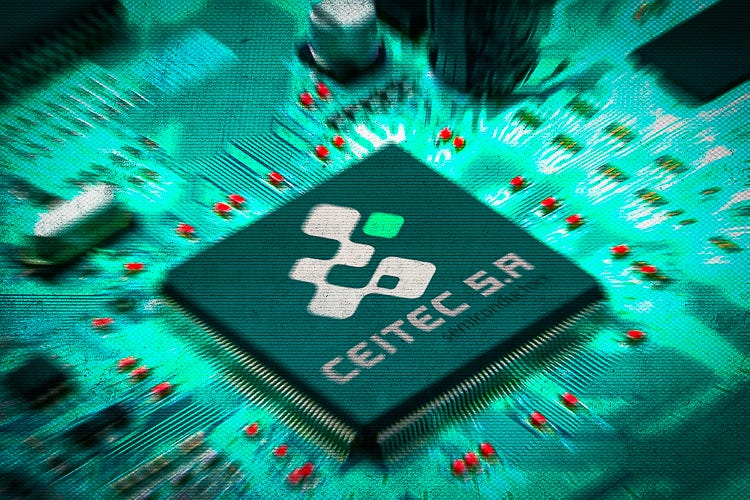
Jair Bolsonaro shut down Brazil’s public company Centro Nacional de Tecnologia Electrônica Avançada S.A, or CEITEC in 2020. Lula reopened it in 2023. Today it operates a technology center specialized in project development and fabrication in microelectronics, i.e. integrated circuits, or "chips”. (Photo: PT)
The rule is not a general embargo, and there is no evidence that it has halted any research center or canceled any Brazilian investment. Its mechanism is more precise. The Commerce Department can review each application under criteria set in Washington, including national security, foreign policy and whether the destination country cooperates with U.S. export enforcement. The U.S. government says the aim is to keep computing capacity from being diverted to Chinese companies and other recipients it considers sensitive. Brazil is not the only target, but it is now subject to the tool. When access to equipment can depend on a foreign authority, the ability to invest no longer guarantees the ability to produce.
This vulnerability did not begin in November. Brazil once pursued an industrial strategy that treated technological mastery as part of national development, and the National Informatics Policy of 1984, for all its flaws, reflected that ambition. The economic crisis of the 1980s, the trade opening of the following decade and a series of shifting industrial priorities changed the course without leaving behind a base able to compete in the most complex segments of electronics. Several sectors made real progress, and it would be false to blame a single administration for the lag. What the decades had in common was erratic funding, weak domestic suppliers and a lasting confidence that the components Brazil did not make would always be available abroad.
Ceitec captures that history. The public company was created to develop expertise in microelectronics, and President Jair Bolsonaro authorized its dissolution in December 2020. The Federal Court of Accounts (TCU) recorded 110 layoffs between February and August 2021, along with a halt in production and sales. President Luiz Inácio Lula da Silva authorized the reversal in November 2023. Reviving the company was necessary, but the interruption left a cost that revoking a decree does not erase. Engineering teams, applied knowledge and manufacturing capacity take years to build, and they can be taken apart far faster than they can be rebuilt. While industrial powers raced toward the next generation of semiconductors, Brazil was still working to keep one of its few public companies in the sector alive.
In December 2025, the Ministry of Science, Technology and Innovation reported that more than 85% of the chips used in Brazil were imported. That does not mean Brazil lacks expertise, since the country has real strengths in chip design, packaging and industrial uses. But knowing how to design a chip is not the same as being able to manufacture it at scale, and the 85% figure shows how far Brazil is from that goal. The dependence also goes well beyond chips. Brazil relies on foreign suppliers for software licenses, network components, sensors, specialized equipment and maintenance.An investigation published by Código Aberto into the digital infrastructure inherited from the cycle that began in 2016 found the same pattern in government systems. Databases can remain in public custody and still rely on proprietary technology to run, to be audited and to be recovered. Owning an asset does not mean controlling every condition of its use.
The warnings were explicit. In July 2025, in “The Illusion of Digital Sovereignty: A Necessary Warning to the Lula Government,” I cautioned that installing servers on Brazilian soil was not enough while the software, support, updates and legal jurisdiction remained tied to foreign suppliers. In September, in “Brazil Invests R$23 Billion in AI: Sovereignty or Dependence?” I examined the R$23 billion (about $4.1 billion) the government planned to spend on artificial intelligence. I called for a second source of hardware, stockpiles of critical components, tested portability between suppliers, contract clauses allowing Brazil to exit and knowledge transfer. The goal was never technological isolation. It was to build alternatives before a crisis made switching impossible or prohibitively expensive.
Those warnings have come true. On Oct. 16, 2025, in “The Geopolitics of Semiconductors: The Chip War,” I wrote that the granting or denial of an export license could alter the technological path of an entire country. I did not anticipate this rule, but I did identify license control as a tool of power over the pace of innovation. In February 2026, in “The Cost of Taxing Technology,” I raised another side of the same vulnerability, this one domestic: making machines and information technology goods more expensive, with no effective Brazilian substitute, can delay the very modernization an industrial policy should promote. A sovereign strategy must protect domestic production without turning the need to import technology into a penalty on productive investment.
More recently, in “The AI Passport,” I looked beyond the single chip to the credentials, controls and networks of trust that are beginning to govern the movement of minerals, equipment and computing capacity. The contest is not just over who sells the most servers. It is over who decides which suppliers are accepted, which companies get preferred access and what conditions a country must meet before it can expand its systems. The Nov. 16 decision makes that question immediately Brazilian.
Journalists and researchers were not the only ones who saw the threat. In Opinion SEI No. 1749/2025, prepared while REDATA, the data center incentive regime, was being drafted, the Ministry of Finance acknowledged that an estimated 60% of Brazilian digital workloads are processed abroad, along with the geopolitical risks of that dependence. The assessment concerned data infrastructure and did not foresee the semiconductor rule announced now. Even so, the ministry put the possibility of unilateral restrictions and a loss of autonomy on the record. The risk was described in the government’s own papers.
It would be just as wrong to say Brazil did nothing. The revival of Ceitec, the Brasil Semicon program and the Brazilian Artificial Intelligence Plan, which budgets R$23.03 billion (about $4.1 billion) from 2024 to 2028, are concrete responses. But scattered initiatives moving at different speeds do not necessarily add up to the capacity to withstand an external restriction. The test of a technology policy is not the money announced or the equipment installed. It is how many critical applications can switch suppliers, how long they can run without replacement parts, which Brazilian teams know how to maintain them and how much of the infrastructure can grow without anyone else’s permission. Without those answers, sovereignty is hard to verify.
This is where REDATA stops being merely a tax policy. Law No. 15,504, signed in September 2026, offers incentives to attract data centers and sets commitments on sustainability, research and service to the Brazilian market. It requires research, development and innovation spending equal to 2% of the value of the goods that receive incentives, and it requires companies to offer at least 10% of their capacity to the domestic market. But the law lets a company replace that second obligation with an additional investment, equal to 10% of the value of the incentivized equipment, in research and innovation projects. That money can build useful knowledge. It does not guarantee that Brazilian companies, universities or public services will have computing capacity available when they must compete for it.
The U.S. rule bears directly on that design. A Brazilian company planning to install advanced accelerators may need a license that an operator controlled by a U.S. parent company, in the same situation under this rule, would be spared if it meets the reporting requirements. The actual competitive effect will depend on specific projects, technical classifications and later decisions, none of which has been demonstrated. The risk is nonetheless easy to see: Brazil could offer public incentives to projects that do not compete on equal terms for access to essential components. That is not an argument against foreign capital. It is an argument against letting a policy meant to reduce dependence help entrench a technological advantage set outside the country.
On Nov. 16, the sector was still waiting for the regulation needed to qualify companies for REDATA, with open questions that included energy requirements and which goods the incentives cover. The Brazilian government was still calibrating its policy while the United States had already set a new condition for access to advanced chips. The two decisions are not legally equivalent, and there is no evidence that REDATA benefits were granted improperly. But the comparison shows the gap between encouraging companies to build infrastructure and ensuring that Brazil has the power to direct its expansion.
A denied license or a delayed shipment is more than an accounting inconvenience. It can disrupt a laboratory’s schedule, keep a Brazilian company out of a market, set back a university’s research or hold up the expansion of an essential service. As of this date, there is no basis to say the new rule has caused widespread stoppages. There is reason to expect delays, higher costs and opportunities concentrating among the groups best equipped to negotiate contracts and manage compliance. Smaller firms, public research centers and innovation workers are likely to have the least room to absorb that uncertainty.
The chip case is a warning about a larger structure. Embraer designs aircraft but relies on foreign suppliers for key propulsion and avionics systems. Petrobras has mastered deepwater oil exploration but uses equipment, software and services from international groups. Banks and government agencies run their own systems on proprietary technology at critical layers. The U.S. rule does not automatically halt any of these activities, and not every one of these sectors depends on the semiconductors now controlled. What they share is that a critical step that cannot be replaced in time can limit the whole. The power of an industrial chain tends to show itself at the one link a country cannot swap out.
That is how technological inequality turns into social inequality. A multinational company can relocate operations, buy ahead or absorb compliance costs. A public laboratory or a small Brazilian manufacturer rarely has the same options. When investment and research slow, the potential damage reaches skilled jobs, productivity, scientific training and the government’s ability to serve the public. The fight for technological sovereignty is not abstract, and it is not about the prestige of owning machines. It is about how work, income and the knowledge those machines make possible are distributed.
The old international division of labor has found a modern form. Countries on the periphery can supply energy, minerals, land, data and incentives, while a few companies keep control of the processors, the intellectual property, the networks and the licenses. That arrangement is not inevitable, but it will not be undone by the fantasy of making everything at home right away. Some dependencies need to be reduced, and others need planned exits for as long as they last. Diversifying contracts, training Brazilian teams, requiring interoperability and maintaining tested alternatives all cost money. Failing to do so could cost Brazil its development schedule.
Lula faces the task of turning worthwhile programs into a state policy that outlasts any one government, includes industry and public science, and treats critical components as a matter of strategic planning. That will mean mapping dependencies sector by sector, setting production priorities, testing substitutes and tying public benefits to measurable gains in autonomy. The question is not which great power to ask for permission. It is how to widen Brazil’s freedom to negotiate so that it is not paralyzed when a supply route closes. History will not ask the country to guess every decision made in Washington. It will ask what Brazil did with the warnings it received before that decision.
Reynaldo Aragon is a journalist who specializes in the geopolitics of information and technology. His work focuses on the relationships among technology, cognition and behavior. Aragon is a researcher at the Center for Strategic Studies in Communication, Cognition and Computing (NEECCC), which is part of the National Institute of Science and Technology on Disputes and Informational Sovereignty (INCT DSI).
This opinion piece, which does not necessarily reflect the editorial opinion of Panamerican Dispatch, first appeared in Brasil 247, was translated with express authorization of its editor-in-chief, and can be read in its original Portuguese here.