


Brasil 247
Brazil has arrived at the decisive week of an election that comes down to a choice that is more important than any single contest between candidates. What’s being decided is the path the country will follow in the coming years: the kind of development it wants to build, the degree of social justice it wants to achieve, and the strength of its democratic institutions.
A future of growth and justice is still being written. And in this election, that future finds its political expression in the candidacy of Luiz Inácio Lula da Silva.
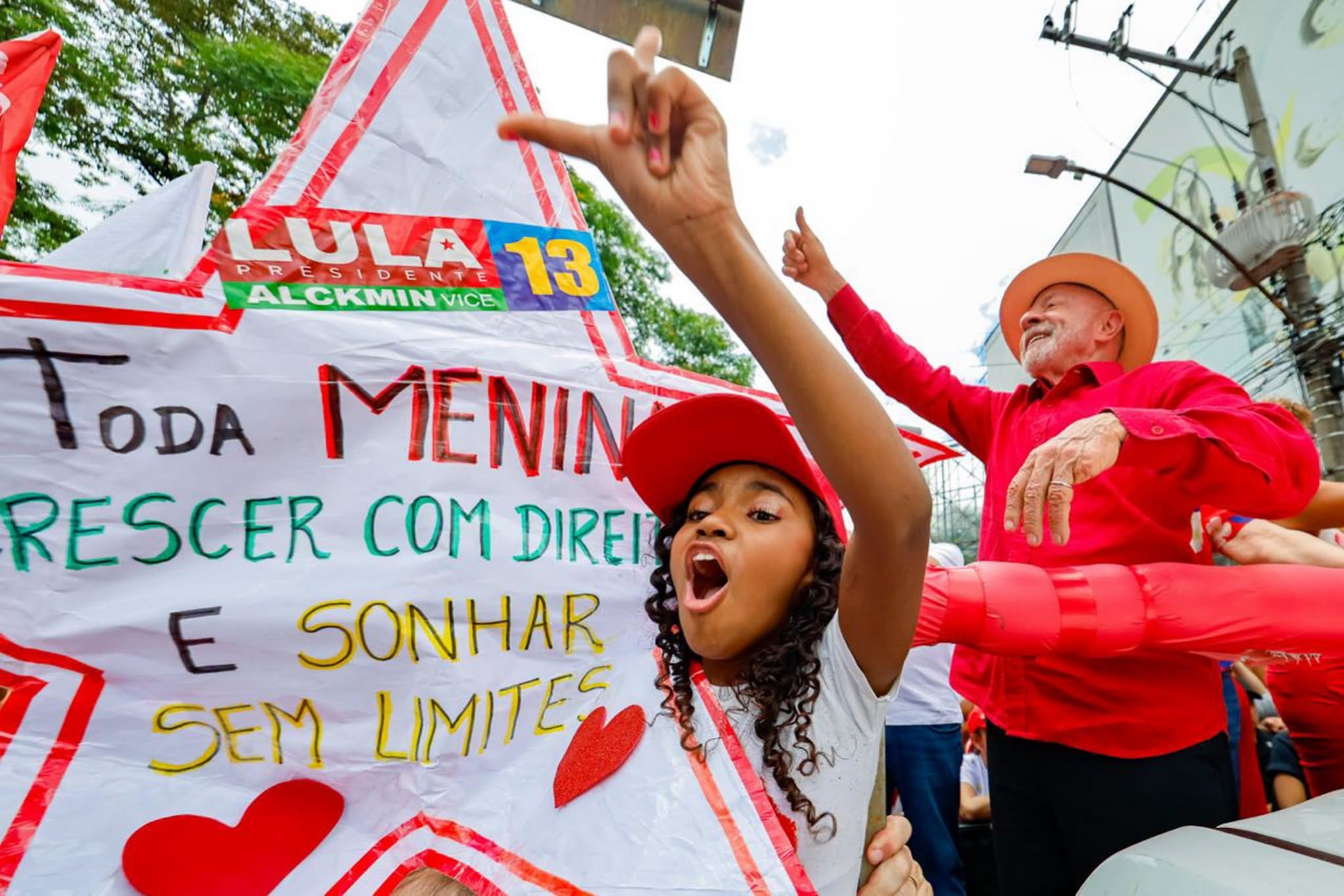
“Every girl grows up with rights and unlimited dreams, ” reads sign at Lula rally in Juiz de Fora, MG (photo: Rickardo Stuckert)
The choice rests with voters. But the outcome will also depend on whether those who support this project can explain their reasons, present their results, answer doubts and persuade those who can still change their minds. This final week is, in that sense, a week of political and democratic action.
It’s time to turn awareness into participation. It’s time to talk to people who are still undecided, clear up doubts, and show, with facts and arguments, why Brazil should keep moving forward toward growth, reduced inequality, respect for workers, protection of rights and a stronger democracy.
The French phrase prise de conscience describes the moment when something known only on the surface becomes deeply understood. Events stop feeling like distant facts and start being understood as part of collective choices, with real consequences for society and for the country’s future. That kind of understanding is exactly what this final week calls for.
Every voter can come to understand what’s at stake more clearly. Every citizen can talk to another citizen. Every argument can reach someone who hasn’t decided yet. Every change of mind can come from a new understanding of the country and the future people want to build.
Changing one’s vote, in this sense, is a legitimate part of democracy. It’s the moment when someone, faced with arguments, facts and experiences, decides to reconsider their choice. Changing one’s mind can be an act of intellectual independence. Voters owe loyalty not to a candidacy, but to their own convictions about the country they want. When new information reshapes that understanding, changing course is also an exercise of freedom.
That’s why this week should be dedicated to persuasion. To persuade doesn’t mean to pressure. It means presenting reasons, showing results, comparing platforms, listening to objections and responding to them. It means treating every voter as someone capable of weighing arguments and making an informed decision.
Brazil has a real opportunity in front of it to keep building growth paired with social justice. That path needs to be defended publicly by everyone who believes in it.
There are concrete tasks for this week. The first is to understand what’s actually at stake: examining the candidates’ proposals, platforms, public records and past decisions, distinguishing promises from policies that were actually implemented, and weighing the consequences of the alternatives on the table.
The second is to break through disbelief and passivity. People need to be shown, through argument, why what’s being decided matters, and helped to understand that their choice can shape the country’s future. Voters should be invited to assess what has already been accomplished, recognize the improvements that have been made, and reflect on the freedom they have to decide, participate and help determine where society is headed.
The third is to talk without humiliating others. Democratic dialogue works precisely because it recognizes the other person’s capacity to think for themselves. Listening to doubts, presenting evidence and responding to objections with respect are far more powerful tools than intimidation.
The fourth is to take part in public life. Democracy happens at the ballot box, but it also happens in everyday conversation, in following public policy, in holding leaders accountable, in defending rights and in demanding that commitments be kept.
The fifth is to defend the future one believes is best for the country. Anyone who believes in growth, jobs, reduced poverty and inequality, a stronger democracy, national development and sovereignty carries a special responsibility this week: to make that case and try to persuade.
There are moments when history offers a society the chance to choose between different futures. In those moments, individual awareness meets collective responsibility.
Brazil is the life of millions of people: the jobs people depend on, the income that supports a family, children’s schools, health care, retirement, the state’s ability to invest, the protection of rights, and the possibility for every Brazilian to live with more dignity.
That’s why an election matters. And this election matters especially because the future at stake isn’t just the future of one government. It’s the future of a vision for the country.
In this election, Luiz Inácio Lula da Silva’s candidacy embodies the possibility of a Brazil that combines economic growth with social justice, development with inclusion, and sovereignty with democracy.
That future depends on the choices that will be made. And choosing requires awareness. Defending a choice requires arguments. Making that choice prevail requires participation.
What Should Be Done With What We Know?
The decisive question this week is what each citizen is willing to do to turn their convictions into responsible action.
The final week of an election can be an exceptional opportunity to clear up doubts, weigh arguments, assess what has been accomplished, recognize the improvements that have been achieved, and remember that political decisions affect real lives. It can also be the moment when someone changes their mind because they’ve finally understood what’s truly at stake.
That’s the democratic meaning of changing one’s vote. The prise de conscience begins when a citizen realizes that the future also depends on their choices. It completes its first movement when that realization changes their behavior. And it shows its full strength when it turns concern into participation.
There are moments when a country has to win its own future. This is one of them.
The future of growth and justice that Brazil wants is still being decided. Luiz Inácio Lula da Silva’s candidacy embodies that horizon in this election.
That’s why, this week, everything should be done to persuade: talk to those who still have doubts, speak with those who might change their minds, show what has been accomplished and the improvements achieved, remind every voter of the freedom they have to evaluate, decide and participate, compare platforms, answer objections and persuade.
All of this within the law, with respect for every voter’s freedom, and with the certainty that democracy grows stronger when free citizens work to persuade other free citizens.
No election is just a sum of votes. An election is also a choice about the future.
And the future has to be won.
In this decisive week, awareness must become responsibility. Responsibility must become action. And action must become a vote.
Brazil has a future to build. It’s time to act together and win it.
This article was written by Brasil 247’s editorial board, has been translated with express consent by Panamerican Dispatch, and can be read in its original Portuguese here.