


by Jamil Chade
Brazil took steps this week to bring a case before the World Trade Organization to challenge tariffs imposed by U.S. President Donald Trump on Brazilian goods.
The U.S. government blocked the measure during a meeting in Geneva this Tuesday.
The Trump administration claims it seeks an agreement with Brazil and a “reciprocal and fairer relationship”.
Brazil’s Foreign Ministry says it will resubmit the complaint against the U.S. sweeping tariffs in December. Under WTO rules, if a complaint is submitted a second time, the country being challenged cannot block the creation of a panel to examine the trade barriers.
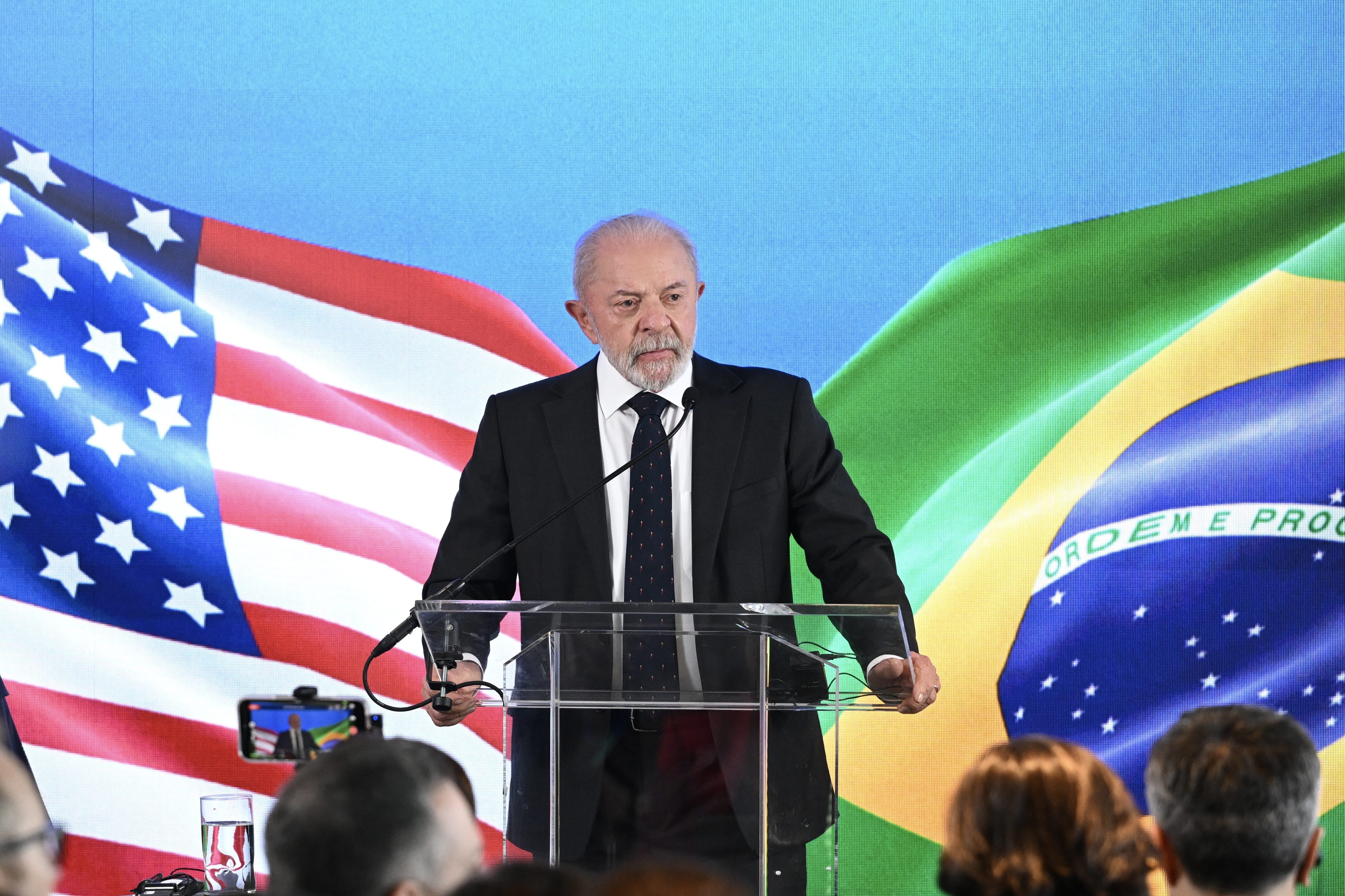
Brazilian President Luiz Inácio Lula da Silva speaks during a press conference at the Brazilian Embassy after meeting with U.S. President Donald Trump in Washington, US., on May 7, 2026. (Photo by Fatih Aktas/Anadolu via Getty Images)
The United States levied tariffs of 25% and 12.5% to Brazilian goods in July after the White House labeled several elements as “discriminatory” against U.S. interests. Among the claims cited by Washington for the imposition of the trade barriers are Brazil’s Pix payment system, Brazilian commercial practices, anti-forced-labor regulations, and even deforestation.
Brazil has rejected these accusations and opted to seek recourse under international law. The Lula administration has thus become the first and, until today, the only government to turn to multilateral bodies to counter Trump’s unilateral agenda on the global stage.
In its statement, the Brazilian delegation argued that the U.S. measures are “incompatible” with American obligations under the 1994 General Agreement on Tariffs and Trade, GATT, and the WTO’s Dispute Settlement Understanding.
According to Brazil’s Foreign Ministry, the United States is discriminating against Brazilian products, exceeding its own schedule of tariff concessions, and unilaterally seeking redress for alleged trade violations outside of established dispute settlement procedures.
In order to initiate a case, however, WTO rules require the consent of all member states, including the country being challenged. At Tuesday’s meeting, the U.S. delegation refused to agree to the proceedings, which postponed the opening of the case.
Taking the floor, U.S. diplomatic representatives explained that the measures were imposed due to “long-standing” concerns over Brazilian trade practices, which they claim are harming “American workers, businesses, farmers, and service providers.”
Another issue raised by the United States is that Brazil continues to import goods produced in third countries using slave labor.
However, the Trump administration’s representatives signaled an interest in reaching an “agreement” with Brazil, aiming for a “fairer and more reciprocal” trade relationship.
Washington officials regretted that Brazil chose to initiate a formal dispute.
Brazil responded by expressing “disappointment” that it had not been possible to advance with the process.
The Brazilian Foreign Ministry has not closed the door to negotiations. For months, the government has been attempting to persuade Washington to put forward a proposal that could bridge the gap between their respective positions. In the meantime, however, Brazil has indicated that it will resubmit its request to initiate legal proceedings in Geneva in mid-December.
The decision to turn to the WTO comes at a time when negotiations over tariffs have reached an impasse, signaling Itamaraty’s willingness to leverage international rules to respond to the Trump administration’s arbitrary actions.
Although the process could take months to conclude, Brazil is seeking a ruling from the WTO that the American barriers are illegal. With such a finding, the government hopes not only to pressure the White House but also to reinforce its argument that these actions violate agreements to which all parties have committed.
Should the WTO accept Brazil’s initiative, it would also serve to validate Brazil’s own trade practices, including its Pix payment system and other commercial policies, as being consistent with international rules.
At the end of September, Brazil attempted to negotiate bilaterally with the U.S. representatives, but without success. The Brazilian Ministry of Foreign Affairs has challenged the 25% and 12.5% tariffs imposed by the Trump administration.
The United States has justified these measures by claiming that certain Brazilian trade practices were harming U.S. companies.
The U.S. government specifically argued that Brazil’s payment system was discriminatory toward American firms.
The U.S. government maintains that the decisions made by the White House are not subject to World Trade Organization rules, asserting that the actions taken against Brazil are based solely on U.S. domestic law.
In a document sent by the Brazilian Ministry of Foreign Affairs to the WTO in Geneva on November 12, Brazil points to trade violations by the White House. According to the report, the massive tariff hikes are “incompatible” with the U.S. obligations under international agreements.
One of the arguments is that the tariffs discriminate against Brazilian products, as they are not applied to other countries. Another alleged violation involves the imposition of duties that exceed the commitments the U.S. made within the WTO, which established maximum levels for trade tariffs.
According to Brazil, the White House is in violation of at least four articles of international agreements.
The White House claims that the Pix payment system harms the competitiveness of U.S. companies in the Brazilian market. It also asserts that Brazil’s trade agreements with Mexico and India unfairly undermine U.S. exports.
The White House has also justified its tariffs on Brazilian goods in defense of U.S. ethanol, deforestation, the protection of intellectual property, and an alleged failure to combat corruption.
This article was originally published by ICL Noticias. It was translated by Panamerican Dispatch. You can read the original, in Portuguese, here.