


by Estéfany Rocha Monteiro
Five days before Brazil’s presidential runoff, an offshore company registered on the Portuguese island of Madeira appeared in a petition submitted to the country’s highest electoral court. Lawyers for President Luiz Inácio Lula da Silva cited a Federal Police investigation reporting that his opponent, Senator Flávio Bolsonaro, had held administrator-level access to a bank account associated with Alcazar Holdings, a company linked to his longtime associate, lawyer and businessman Willer Tomaz. The reference to an account abroad brought an existing police inquiry into an increasingly public confrontation over the candidates’ personal finances1.
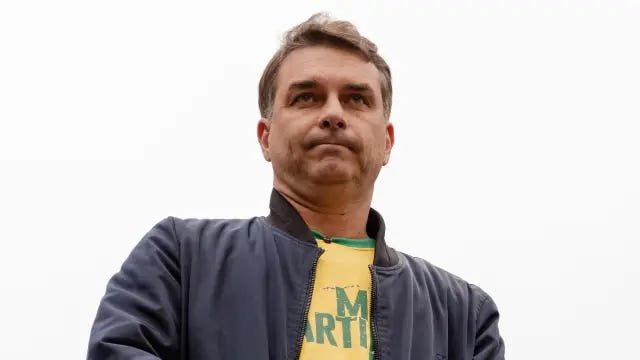
Far right presidential candidate Flávio Bolsonaro (Maira Erlich/Getty Images)
The confrontation had begun during a televised debate on 18 October, when Lula, seeking re-election, challenged Flávio, the eldest son of former president Jair Bolsonaro, to disclose banking and telephone records relating to themselves and their families. Two days later, Lula’s lawyers submitted a conditional authorisation for the examination of eight years of banking, tax and telephone information concerning the president, his wife, his five children and related companies. In Brazil, presidential candidates must already declare their assets and report campaign expenditure to the electoral authorities. Lula’s challenge went further, proposing access to private transactions and communications, provided his opponent accepted a reciprocal examination2.
Flávio replied on 21 October by offering access to twenty years of his own records, together with information concerning relatives and companies, and by proposing to disclose messages exchanged with Daniel Vorcaro. Vorcaro had controlled Banco Master, a Brazilian bank whose liquidation in November 2025 was followed by investigations into suspected fraudulent financial operations and its dealings with political and business figures. The senator’s twelve-page response also set out nineteen demands, among them records relating to Lula’s children, businesses, former aides, the Lula Institute, presidential expenses and meetings with the banker, with certain requests reaching back to 2003. Claiming that transactions might have passed through intermediaries, Flávio sought a wider inquiry into people around the president; Lula’s campaign accepted the additional conditions while maintaining its demand for reciprocal disclosure3.
The two campaigns met on 22 October at Brazil’s Superior Electoral Court (Tribunal Superior Eleitoral, TSE), the institution responsible for administering national elections and adjudicating electoral disputes. Lula signed the proposed arrangement himself, while Flávio’s lawyer, Maria Claudia Bucchianeri, signed on the senator’s behalf. An argument over the inclusion of Alcazar Holdings delayed agreement until Flávio’s representatives accepted the company’s inclusion. Lula’s team presented authorisations and other papers, and Flávio’s lawyers said they would examine those materials before providing their own. By Thursday afternoon, the parties had reached an understanding, while requests to financial institutions, judicial decisions on disclosure and the publication of any underlying records remained ahead4.
Brazil has encountered presidential financial disclosures through different procedures. Every candidate submits an asset declaration, and in 2015 a court ordered access to the bank and tax records of former president Fernando Collor during a criminal investigation. This week’s exchange concerns conditional consent by two presidential candidates, with demands that reach relatives, associates and companies. It also draws attention to the length of Flávio’s career: he has held paid public positions since his late teens, and questions about those appointments first surfaced long before his current presidential campaign5.
In December 2000, at nineteen, Flávio obtained a paid appointment in the federal Chamber of Deputies in Brasília, with an official workload of forty hours a week. He was also attending law school and undertaking an internship in Rio de Janeiro, hundreds of kilometres away. BBC News Brasil examined parliamentary records and interviewed people familiar with his activities in 2019, questioning how the three commitments could have been fulfilled simultaneously. The appointments feature in Flavinho de Papai (“Daddy’s Little Flávio”), a documentary presented by Brazilian rapper MC Cabelinho and released on 22 October by the investigative series Revelando (“Revealing”). Two years after his appointment in Brasília, Flávio was elected to the Rio de Janeiro state legislature, beginning sixteen years as a state lawmaker before his election to the federal Senate6.
His years in the state legislature produced a separate inquiry into the salaries of employees in his office. Prosecutors alleged that Fabrício Queiroz, a former police officer and longtime aide, participated in a rachadinha, or payroll skimming scheme, in which legislative employees allegedly returned part of their publicly funded wages to people connected with the office. The investigation examined banking movements, financial intelligence reports and a chocolate-shop business associated with Flávio, who denied wrongdoing. After higher courts invalidated significant evidence gathered during the inquiry, a Rio de Janeiro court rejected the indictment in 2022; the Supreme Federal Court rejected further prosecutorial appeals in 2025. Those rulings form part of the history of the allegations and of the way the case reappears in coverage of his presidential campaign7.
A later Federal Police inquiry brought Flávio into correspondence recovered from Daniel Vorcaro during the investigation of Banco Master. The messages concern efforts to secure substantial financing for Dark Horse, a proposed film about Jair Bolsonaro, and include requests for payment and accounts of meetings with the senator. Flávio has acknowledged approaching Vorcaro for private sponsorship and has denied receiving improper personal benefits or offering favours in return. His promise this week to disclose their exchanges consequently refers to a relationship that investigators and journalists were already examining in connection with the failed bank8.
The same banking investigation also led to Willer Tomaz and Alcazar Holdings. Tomaz, a lawyer and businessman with interests in gambling and payment services, appears in police correspondence that describes Flávio as a “master user” of an account associated with the Madeira-based company and refers to a later request to remove that access. Journalists have reported overlapping business addresses, travel and professional ties between the two men; both reject suggestions that they maintained an illicit financial partnership. The correspondence helps explain the prominence of Alcazar in the negotiations over the disclosure agreement, where access to a company’s banking information became a contested issue9.
Tomaz’s name has also appeared in a property dispute that entered the campaign through Richarlison, the Brazilian international footballer. The player published videos and court documents concerning rights he claims over property on Ilha Comprida (“Long Island”), near Angra dos Reis, on the coast of Rio de Janeiro state, accusing Tomaz and Flávio of involvement in depriving him of those rights. Tomaz disputes the account, citing property documents and judicial decisions in his favour and maintaining that Flávio is outside the litigation. The competing legal claims became another source of public attention to Tomaz’s relationship with the senator, although the property case follows its own judicial course10.
Another part of Flávio’s professional record enters a criminal case through his work as a lawyer. Five-year-old Ana Clara Gomes Machado was fatally shot during a police operation in Niterói, near Rio de Janeiro, in February 2021. Military police officer Bruno Dias Delaroli was charged in connection with her death, and the criminal case was still awaiting a jury verdict in October 2026. Flávio is named among the defence lawyers in an April 2024 decision of Brazil’s Superior Court of Justice concerning an appeal. In O Julgamento que Nunca Aconteceu (“The Trial That Never Happened”), actress Camila Pitanga interviews Ana Clara’s mother, Cristiane, who recounts the family’s years of waiting for the case to be heard11.
While that case concerned Flávio’s legal practice, an investigation published during the campaign’s final week returned to his contacts with businessmen during the pandemic. On 21 October, piauí magazine published Uma Tarde no Lago (“An Afternoon on the Lake”), describing a gathering aboard a boat on Brasília’s Lake Paranoá in July 2020. According to the magazine, Flávio was there with Danilo Berndt Trento and Francisco Maximiano, businessmen seeking dealings with Jair Bolsonaro’s government, including a possible agreement involving the Indian Covid-19 vaccine Covaxin. The report described three sex workers at the gathering and alleged that Trento gave the senator a Rolex watch. Its reconstruction drew on testimony, travel records and material obtained during parliamentary investigations. The reported meeting took place as the pandemic was claiming lives across Brazil and restrictions on gatherings were changing daily life; at publication, Flávio had yet to respond publicly to the magazine’s questions about the encounter12.
The businessmen’s dealings subsequently attracted scrutiny during Brazil’s parliamentary inquiry into the federal government’s pandemic response. Legislators examined the proposed Covaxin purchase, the role of intermediaries and allegations of pressure raised by a Health Ministry official; the government ultimately suspended the purchase. Further reporting said that Flávio later helped arrange a meeting between Maximiano and the head of Brazil’s national development bank concerning another commercial venture. Read alongside the boat investigation, those records trace contacts between businessmen seeking government access and figures connected to the then-president’s family13.
Several episodes of Revelando draw on the documentary and judicial material behind these stories. In Grandes Igrejas, Master Negócios (“Big Churches, Master Deals”), comedian Fábio Porchat examines reported connections among Banco Master, religious organisations and political figures. Pátria Submissa (“Submissive Homeland”) features General Carlos Alberto dos Santos Cruz, a former minister in Jair Bolsonaro’s government who has criticised the political movement’s approach to the United States. Alongside the films presented by MC Cabelinho and Camila Pitanga, the series has placed interviews, court records and older investigations before viewers encountering parts of this history for the first time14.
The publication of Flavinho de Papai (“Daddy’s Little Flávio”) brought a further dispute over the circulation of that material. Meta restricted a promotional clip on Instagram under rules concerning artificial intelligence in election content; the documentary’s producers disputed the explanation, and the full film remained available on YouTube. At the same time, searches for a Brasília office identified online as “Room 2601” and for #QuemÉMarianaFlávio (“Who Is Mariana, Flávio?”) were directing users to older articles, business registrations and allegations about the senator. The politician who promoted the hashtag had promised a disclosure but had yet to identify the information behind it15. In that setting, a request to investigate could lead someone to a court record, a documentary interview or an allegation that had scarcely progressed beyond a question circulating online16.
The controversy over Lula’s and Flávio’s proposed disclosure has unfolded amid that uneven circulation of information. Each campaign has demanded the examination of relatives, companies and associates; among the people named is Lula’s son Fábio Luís, who has figured in separate investigations and denies wrongdoing. Meanwhile, the records underlying several investigations of Flávio have been available in court files and news reports for years, while the banking and telephone information promised in the 22 October agreement remains subject to further procedures. Even a complete release would therefore enter a public argument already shaped by older evidence, documentary retellings and allegations circulating during the campaign17.
In the closing days of the runoff, events separated by years began appearing together in the same searches: the official record of a nineteen-year-old parliamentary appointee, police correspondence concerning an offshore bank account, a footballer’s court papers and the filmed testimony of a mother still waiting for a criminal trial. Their circulation has made parts of Flávio’s long political and professional career newly visible, while placing records with different legal histories before an audience encountering them within a matter of days. A ruling that ended one prosecution can appear beside documents from an ongoing inquiry, with both presented as evidence for an argument about the candidate. The sequence through which each record was obtained, challenged or examined is harder to recover from a viral clip than from the files themselves.
The agreement signed on 22 October may bring further information into that public record, depending on the disclosures the court orders and the materials the candidates provide. Until then, the available files describe proceedings at markedly different stages: a former staff-salary prosecution ended after judicial rulings on evidence, the Banco Master inquiries continue, and the criminal case concerning Ana Clara’s death awaits a jury. The campaign has brought these histories together in the final week before the vote, although the institutions responsible for them work according to schedules of their own. When Sunday’s result is announced, the dispute over the candidates’ financial disclosures will still be measured against the records actually produced, and Ana Clara’s mother will still be waiting for a court to hear the case arising from her daughter’s death.
Estéfany Rocha Monteiro is a Brazilian lawyer and human-rights researcher
Endnotes
1 Lula’s TSE petition, 20 October 2026, pp 1–3; CNN Brasil, 22 October 2026, account-access records
2 Agência Brasil, 20 October 2026; TSE, candidate asset reporting, September 2026
3 Vorcaro controlled Banco Master, liquidated in November 2025; the securities regulator fined him in September 2026 in a separate fraudulent fund case.; Flávio’s petition, 21 October 2026, pp 4–12; SBT News, 21 October 2026, disclosure of Vorcaro messages; Agência Brasil, financial-regulator decision, 8 September 2026
4 Poder360, agreement and remaining court steps, 22 October 2026; O Povo, campaign statements, 22 October 2026
5 TSE disclosures, September 2026; Collor order, 18 May 2015
6 BBC News Brasil, Matheus Magenta, 23 January 2019; Revelando, “Flavinho de Papai” (full episode)
7 Brazilian Supreme Court, evidence ruling, 30 November 2021; Agência Brasil, rejected indictment, 16 May 2022; Supreme Court, appeals, 27 February 2025
8 Police report and messages, CNN Brasil, 12 September 2026; Flávio’s response, Agência Brasil, 13 May 2026; Banco Master messages, piauí, 1 October 2026
9 Willer Tomaz is a lawyer and businessman whose commercial relationships with Flávio, gambling enterprises and corporate accounts have attracted police attention.; PF account-access report, CNN Brasil, 22 October 2026; Folha, shared businesses and journeys, 22 October 2026
10 Poder360, Richarlison and Tomaz court documents, 22 October 2026; CNN Brasil, 21 October 2026
11 STJ, AgRg no AREsp 2.240.835/RJ, 9 April 2024, pp 1–3; Revelando, “O Julgamento que Nunca Aconteceu”
12 piauí, “Uma tarde no lago”, 21 October 2026, as reported by Folha; Reporting on underlying testimony and flight records
13 Folha, 21 October 2026, Covid commission and BNDES links
14 Revelando, “Grandes Igrejas, Master Negócios”; Revelando, “Pátria Submissa”; Revelando, official channel
15 On 21 October 2026, Brazilian congressman André Janones encouraged followers of his WhatsApp mobilisation channel, Exército do Lula (“Lula’s Army”), to circulate the hashtag #QuemÉMarianaFlávio (“Who Is Mariana, Flávio?”), suggesting that he possessed undisclosed information concerning presidential candidate Flávio Bolsonaro. The campaign prompted renewed attention to Mariana Lúcia da Silva Ramos Mota, a former chief of staff in Flávio’s office at the Rio de Janeiro State Legislative Assembly, who had been named in investigations into alleged salary-diversion arrangements known as rachadinhas. Janones subsequently disputed the media’s interpretation of his announcement and stated that he had yet to disclose the information in question. See UOL, 21 October 2026; Poder360, 21 October 2026; and report on Janones’s clarification, 22 October 2026.
16 Folha, teaser restriction, 22 October 2026; UOL, “Room 2601”, 21 October 2026; UOL, Mariana hashtag, 21 October 2026
17 Reuters, both sides’ expanded requests, 21 October 2026; Poder360, TSE agreement, 22 October 2026