


by Felipe Rabioglio
The Liberal Party (PL) deleted a Flávio Bolsonaro ad on Saturday morning after it was found to resemble a propaganda piece used by Italian fascist dictator Benito Mussolini in 1934. Bolsonaro’s party had posted the ad on its official WhatsApp channel. When ICL Notícias reached out, the party denied any reference to fascism and apologized for what it called a mistake.
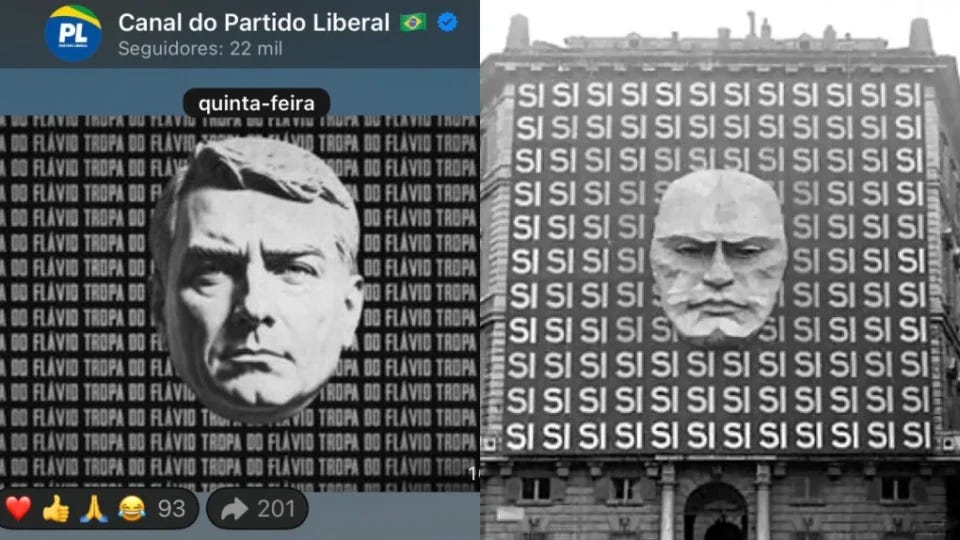
The graphic showed the senator’s face in black and white, surrounded by the phrase “Tropa do Flávio,” or “Flávio’s Troops,” repeated over and over. The format echoed a propaganda display once shown on the facade of the Palazzo Braschi in Rome, where an image of Mussolini was surrounded by the Italian word “SÌ,” meaning “yes.”
In a statement sent to ICL Notícias, the party said the material was produced by its youth wing, the Young Liberal Party, and was inspired by ancient graphic design. The party denied any intention to reference Italian fascist propaganda and said the content had already been taken down.
Odilon Caldeira, a professor at the Federal University of Juiz de Fora and coordinator of the Far Right Observatory, analyzed the similarities. He said the post may have been used as a strategy to provoke reactions from political opponents and shape the election debate.
Mussolini Propaganda Dates to 1934
The historical photo used for comparison was taken in March 1934, during Italy’s fascist regime. At the time, the facade of the Palazzo Braschi, which housed Rome’s fascist federation, was covered with a massive composition featuring Mussolini’s face and the repeated word “SÌ.”
The propaganda was tied to a plebiscite held that year, in which Italians were asked to approve or reject a single list of candidates preselected by the regime. The vote took place amid political repression, with no genuine democratic competition.
The image was designed to link Mussolini’s image to popular approval of the regime. The photograph has since become one of the most recognized records of political propaganda from Italy’s fascist dictatorship.
“This is clearly a reference to fascism,” Caldeira told ICL Notícias. He connected the visual composition to the spirit of obedience and domination characteristic of totalitarian aesthetics.
Historian Sees Possible Attempt to Shift the Election Debate
Despite identifying the historical reference, Caldeira said the post shouldn’t necessarily be read as an attempt to win over neofascist groups.
In his assessment, the ad could instead represent a strategy to provoke criticism labeling the Bolsonaro movement as fascist, shifting the election debate onto less favorable ground for winning votes.
Caldeira argues that using the term “fascist” in everyday political discussions tends to trigger defensive reactions among voters who identify with the Bolsonaro movement. That, he said, can make it harder to reach undecided voters or those unhappy with Flávio Bolsonaro’s candidacy.
In that scenario, Caldeira said the controversy could lead the senator’s opponents to spend time and energy arguing over ideological labels, pushing aside issues with greater potential to actually sway voters.
The idea that this could be a deliberate communication strategy is a hypothesis Caldeira raised himself. The Liberal Party, for its part, denied that the post had any intentional connection to Mussolini’s propaganda.
Read the Liberal Party’s Full Statement
“The Young Liberal Party produced a post inspired by ancient graphic design, with no intention of referencing the image in question. Even so, the content has already been taken down. The party apologizes for the mistake and for any interpretation arising from this coincidence.”
This article was original published by ICL Notícias, was authorized for translation by Panamerican Dispatch by its editor-in-chief, and can be read in its original Portuguese here.