


Darren Beattie, a senior State Department adviser on Brazil and one of the Bolsonaro family’s main contacts in the Republican administration, has left his post. A critic of President Lula and of Federal Supreme Court Justice Alexandre de Moraes, Beattie departs less than a month after Lula, of the Workers’ Party (Partido dos Trabalhadores/PT), defeated Sen. Flávio Bolsonaro of the Liberal Party (Partido Liberal/PL) in Brazil’s presidential election.
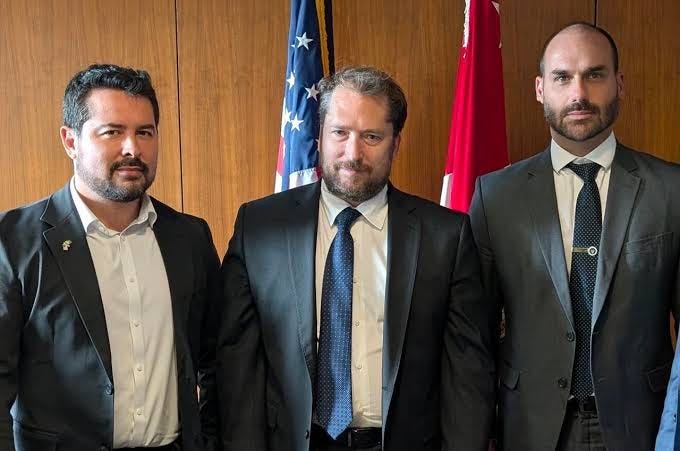
Left to right, Paulo Figueiredo, Darren Beattie and Eduardo Bolsonaro (Photo: social media)
U.S. media outlets first reported the departure, and people close to Beattie and a State Department official later confirmed it to the newspaper Folha de S.Paulo. The department did not explain why he left, but a spokesperson told Folha that it thanked Beattie for his service to the “America First” State Department and wished him “success in his future endeavors.”
The departure comes as Democratic lawmakers in Congress move to investigate the Trump administration’s actions on Brazil, and as the administration deals with the fallout from Republican losses in this month’s midterm elections.
Ties to the Bolsonaro family
The State Department formally named Beattie senior policy adviser for Brazil in February 2026, the first time it ever dedicated a representative to the country. Even before he took the post, Beattie was connecting Bolsonaro allies with administration officials, among them former Rep. Eduardo Bolsonaro and businessman Paulo Figueiredo, the grandson of Brazil’s last military dictator Joao Figueredo who has lived in Florida since 2015..
In August 2025, as Washington stepped up pressure on Brazil’s judiciary, Beattie called Justice Moraes the “beating heart of the persecution and censorship complex against Jair Bolsonaro.” Eduardo Bolsonaro publicly thanked Beattie for his work while the United States imposed financial sanctions on Moraes under the Magnitsky Act, which Washington lifted in December 2025 after Lula and the White House grew closer diplomatically.
Lula’s government barred Beattie from Brazil
In March, Beattie set off a diplomatic dispute between Brasília and Washington when he planned a trip to Brazil that included meetings with Flávio Bolsonaro, then a presidential hopeful, and events that cast doubts on the integrity of Brazil’s electoral system. He also planned to visit former President Jair Bolsonaro, who was serving his sentence at the Papudinha prison complex in Brasília. Moraes first authorized that visit but reversed himself after Foreign Minister Mauro Vieira warned of the risk of foreign interference in Brazil’s internal affairs during an election year.
Lula then announced a ban on Beattie entering Brazil, in response to the U.S. decision to cancel the visa of Health Minister Alexandre Padilha, also of the Workers’ Party. Brazil’s Foreign Ministry said it revoked Beattie’s visa for “omitting and falsifying relevant information about the reason for the visit,” because he had told Brazilian authorities he would attend a rare earth minerals event in São Paulo.
Beattie kept in touch with the Bolsonaro family in Washington even after the episode. In May, he met with with Flávio Bolsonaro, who also visited the White House and the State Department, where he met Secretary of State Marco Rubio and Deputy Secretary of State Christopher Landau.
Democrats alleged interference in Brazil’s elections
Beattie’s role in Brazilian politics drew questions from Democrats. In September, Sens. Jeanne Shaheen, Tim Kaine and Peter Welch sent Rubio a letter that named Beattie and accused the administration of trying to interfere in Brazil’s electoral process. In October, days before the presidential runoff, Reuters reported that Beattie and Ricardo Pita, another State Department official, were running a campaign inside the administration to help the Bolsonaro family return to power. The State Department told Reuters that its efforts against drug trafficking and for free speech aimed to protect U.S. citizens. Beattie also pushed to designate the First Capital Command (PCC) and the Red Command (CV) as terrorist organizations, a move Lula’s government opposed.
Beattie’s roots on the U.S. far right
Beattie has ties to the American far right. He worked as a speechwriter in Trump’s first term, until the White House fired him in 2018 after reports that he had attended a conference of white nationalists two years earlier. During the 2024 presidential campaign, he faced accusations of racism and misogyny for arguing on social media that white men should hold leadership positions.
Beattie returned to the federal government when Republicans retook the White House in January 2025. Before taking over Brazil policy, he worked in public diplomacy and helped dismantle the State Department office responsible for fighting foreign disinformation.
This article first appeared in Brasil 247, was translated with express authorization of its editor-in-chief, and can be read in its original Portuguese here.