


by Rodrigo Chagas
On Friday, October 6, Pedro Alliana was ushered in as President of Paraguay. His ascension followed the impeachment of President Santiago Peña amid the Ueno Bank crisis.
Members of Javier Milei’s administration in Argentina applauded Alliana’s arrival to power. According to an Argentine official who spoke to the news channel TN, the new Paraguayan president is “even further to the right and closer to Milei’s ideas than Santiago Peña was.”
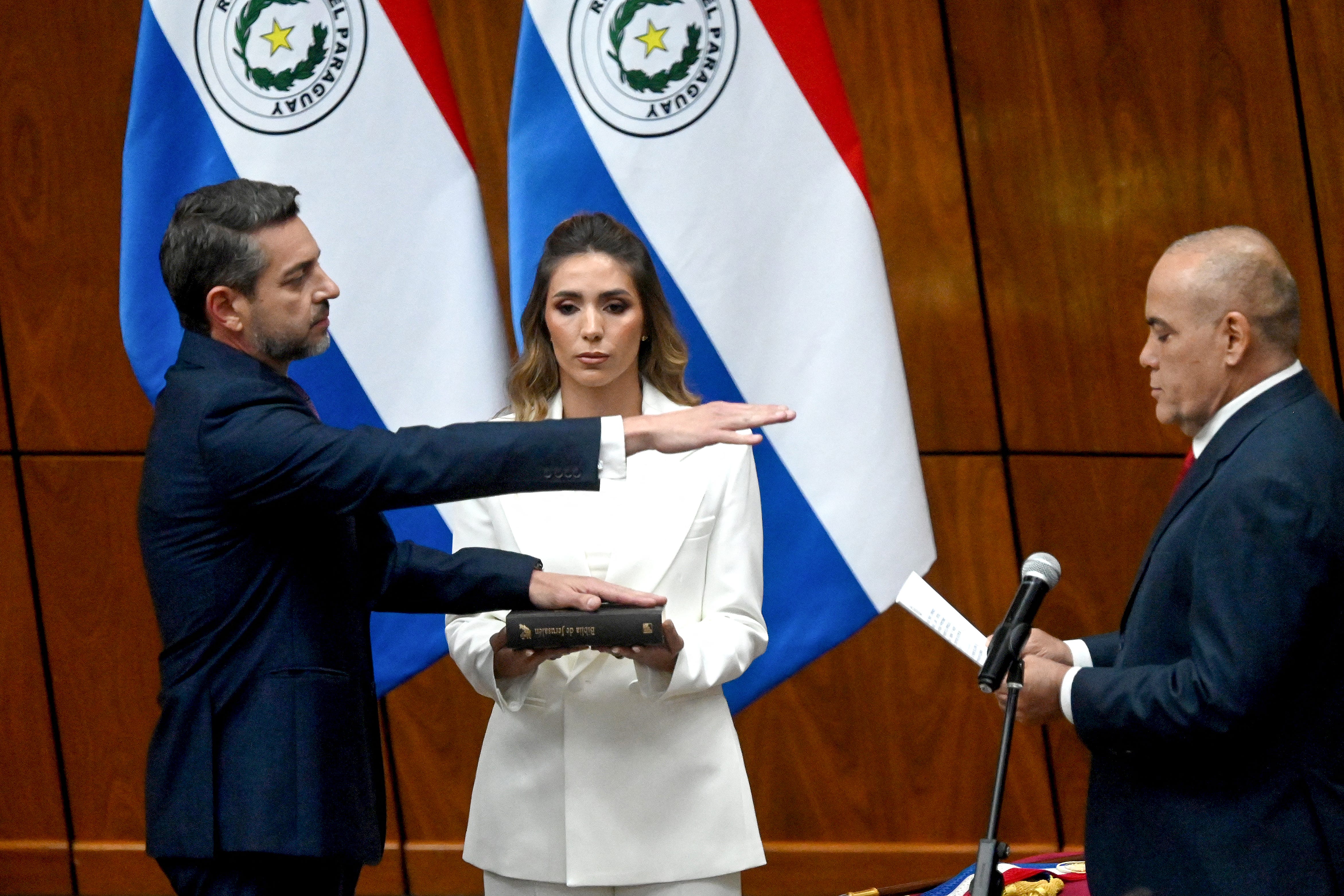
Paraguay’s Vice President Pedro Alliana takes the oath of office as Interim President after the impeachment of President Santiago Pena at the National Congress in Asuncion on November 6, 2026. (Photo by DANIEL DUARTE / AFP via Getty Images)
This assessment is supported by recent statements from the 52-year-old politician, who built his political career within the traditional Colorado Party and, more recently, has aligned himself with religious-based rhetoric and international conservative leaders.
During the 2023 presidential campaign, Alliana declared that his party stood for the teachings of God and the Bible, as well as for life, family, and private property. He presented his party as a bulwark against abortion and what is termed “gender ideology.”
A former governor of the Ñeembucú department, a member of parliament, and a former president of both the Chamber of Deputies and the Colorado Party, Alliana assumed the vice presidency in 2023 as part of the ticket with Peña.
From the Colorado Party to Religious Conservatism
Alliana’s national prominence emerged within “Honor Colorado,” a faction of the Colorado Party led by former president Horacio Cartes, who governed Paraguay from 2013 to 2018.
Cartes is a businessman with interests in the financial, tobacco, and agricultural sectors. He solidified his influence over the party and served as the primary architect behind the election of both Peña and Alliana. His administration pursued policies of economic liberalization and expanded partnerships with the private sector. The Colorado Party supported the dictatorship of Alfredo Stroessner (1954–1989) and has governed Paraguay since 1947, with the exception of the period between 2008 and 2012, when Fernando Lugo served as president.
In 2023, during Joe Biden’s term, Cartes was the target of financial sanctions by the United States, following accusations of corruption and the payment of bribes to officials. He denies any wrongdoing. The sanctions were lifted by the Donald Trump administration in October 2025, a decision publicly celebrated by Alliana.
The defense of religious agendas was already present in the rhetoric of the new Paraguayan president back in 2018, when he led the Colorado Party. During an event held by the Republican Institute for Strategic Policy, a party-affiliated organization that adopted the motto “God, Homeland, and Family”, Alliana declared: “We say no to abortion, and we defend the fundamental values we hold as a nation: our history and our Christian principles.”
This narrative also featured prominently in the 2023 campaign. Alliana claimed that foreign nations intended to introduce abortion and so-called “gender ideology” into Paraguay, describing the Colorado Party as a bulwark in defense of life and the family.
That same year, he called for the elimination of an educational cooperation agreement between Paraguay and the European Union, alleging that foreign funds could be used to finance gender-related content in schools.
The European Union denied having any influence over the Paraguayan school curriculum and clarified that the funding was not contingent upon the adoption of any specific educational content. A study by the International Institute for Democracy and Electoral Assistance (International IDEA) identified similarities between the propaganda used in the Peña-Alliana campaign and the materials disseminated by Jair Bolsonaro against Lula in 2022. According to the research, both campaigns employed comparisons over abortion, gender, censorship, and public safety to attack their opponents.
Anti-communism also appears in statements made by the Colorado Party leader. In January 2022, Alliana celebrated his party’s return to power in 1947, describing the event as a popular reaction against communism. Paraguayan historians have challenged this interpretation, pointing out that the political shift actually followed a self-coup by General Higinio Morínigo.
U.S. Secretary of State Marco Rubio and Paraguayan Foreign Minister Ruben Ramírez sign a Memorandum of Understanding concerning Strategic Civil Nuclear Cooperation at the State Department in Washington, DC, on August 4, 2026. (Photo by Mandel NGAN / AFP via Getty Images)
Alignment with Trump, Milei, and Netanyahu
In recent years, Alliana has strengthened ties with members of the administration of U.S. President Donald Trump. In August 2026, he met with Secretary of State Marco Rubio and Undersecretary Christopher Landau in the United States.
In an interview with the Argentine outlet Infobae, he stated that relations between the two countries were experiencing “an extraordinary moment” and might well be at their historical peak.
Alliana expressed support for the “Shield of the Americas”, a Trump-era initiative aimed at consolidating U.S. hegemony in the region, with an official agenda focused on regional security cooperation and combating organized crime. He also voiced support for Pax Silica, a U.S. program focused on developing supply chains for critical technologies and minerals.
During the visit, the two nations signed a memorandum on civil nuclear cooperation, with Alliana highlighting the potential for exploring uranium reserves within Paraguayan territory.
Military cooperation was further expanded through a Status of Forces Agreement signed with the United States in December 2025 and approved by the Paraguayan Congress in March 2026. The treaty allows for the temporary presence of U.S. military personnel and civilian staff in Paraguay, grants them immunity, and authorizes the United States to exercise criminal jurisdiction over them while on Paraguayan soil.
In Argentina, the new Paraguayan president established direct contact with Santiago Caputo, one of Javier Milei’s key political advisors. The two met at the Casa Rosada in December 2025. Afterward, Alliana publicly thanked the Argentine strategist for gifting him a copy of El Monje, a book detailing his own political career.
Another diplomatic meeting took place with Israeli Prime Minister Benjamin Netanyahu. Alliana visited Israel in October 2026, where he met with the leader and reaffirmed Paraguay’s support for the Israeli government.
In an interview with The Jerusalem Post, he stated that his country would maintain its strategic alliance with Israel, regardless of the political costs. He also defended Israel’s right to “protect its territory” and advocated for the expansion of bilateral cooperation in the fields of security and technology.
In domestic policy, Alliana supported a reform of the Paraguayan public-sector pension system, which sparked protests by teachers in 2026. The proposal introduced changes to retirement rules and employee contributions. Following union mobilization, the then-vice president took part in negotiations that led to modifications in the bill.
Before Peña’s fall, Alliana had been preparing to run for the presidency in 2028. His candidacy caused a rift with Cartes, who withdrew his support for Alliana’s electoral ambitions. Alliana received backing from Colorado Party governors and lawmakers, while Peña had supported his own succession by Alliana.
According to Cony Oviedo, a leader of the Paraguay’s Coordination of Organizations of Rural and Indigenous Working Women, Peña’s replacement does not represent a shift in the power structure.
“The problem isn’t solved by the departure of a single president,” she told Brasil de Fato. She argued that the Colorado Party will remain in control of the country without taking responsibility for the crisis.
Alliana was also implicated in the Ueno Bank scandal. The then-vice president confirmed that he held a certificate of deposit worth 4 billion guaranis (approximately $640,000) at the bank.
The Chamber of Deputies rejected an impeachment motion against him by 48 votes to 30, while approving the impeachment process against Peña. The existence of the investment does not, in itself, prove involvement in the irregularities under investigation.
Peña’s removal, which was supported by Cartes, accelerated Alliana’s rise to power, but it also altered his electoral plans.
Under the Paraguayan Constitution, he is required to serve out the remainder of the term until August 2028 and is ineligible to run for presidential reelection.
This article was originally published by Brasil de Fato. It was translated by Panamerican Dispatch. You can read the original, in Portuguese, here.
blow your mythical book up and out your arse. k thanks
Look at the Nazi sign when being swore in. They are in trouble!! The world and the people are.