


by André Uzêda
The controversy surrounding Meta AI and the generation of content concerning President Luiz Inácio Lula da Silva is not the only instance of friction between an artificial intelligence system and the president’s political standing.
On Wednesday, October 14, ICL Notícias reported that the AI integrated into WhatsApp fails to execute prompts requesting images that combine Lula’s name with the number 13, his party’s electoral number. On the other hand, Meta AI generates content, without any restrictions, featuring opposing candidate Flávio Bolsonaro alongside the number 22, which is associated with his campaign.
A comparison with other artificial intelligence tools available on the market reveals that, in general, Big Tech platforms tend to prioritize negative content when asked about the president’s political trajectory or past criminal legal proceedings. That’s even though, as of now, Lula is not a defendant in any active case, nor is he currently under investigation.

(Matteo Della Torre/NurPhoto via Getty Images)
An analysis conducted by a social media monitoring firm, to which the ICL Notícias investigative team gained access, tested various scenarios involving Lula’s name across several AI platforms controlled by Big Tech companies. Our reporting team verified these tests and obtained the same results.
When asked about the reputation of Brazil’s president, Grok describes him as a polarizing figure linked to corruption scandals involving his party and his administration. Grok, which is X’s AI controlled by billionaire Elon Musk, also cites past judicial rulings and controversies associated with Lula. Notably, the social achievements and economic indicators from the president’s three terms in office are absent from this analysis.
In ChatGPT, controlled by OpenAI, when a user asks about legal issues involving President Lula, the response provides a history related to the corruption scandal known as “Operation Car Wash,” and brings up other controversial cases such as the Guarujá triplex, the Atibaia country house, and the Lula Institute.
Only after presenting this compilation, accompanied by small photos for each example, does the text state that “these cases have been closed; there are no valid convictions resulting from them.”
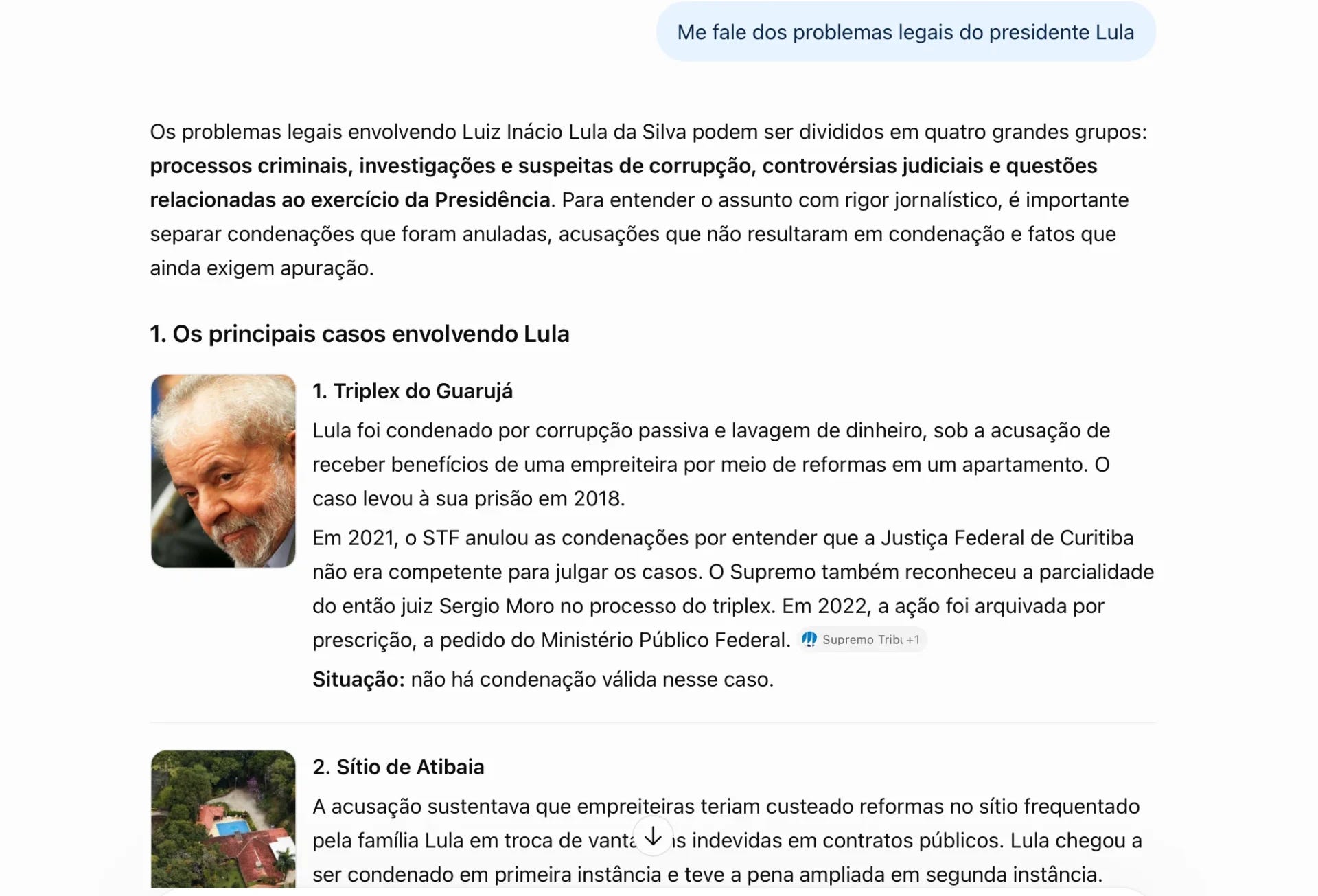
Further down, in a subsequent section of the page, ChatGPT reiterates that “there are no ongoing criminal proceedings from Operation Car Wash against Lula,” and notes that “the main cases ended with the annulment of convictions, the closure of the proceedings, or the expiration of the statute of limitations.”
In the same response, ChatGPT also includes details and a photograph of Fábio Luís Lula da Silva, Lula’s son. The text mentions that “inquiries were authorized to investigate suspicions involving the president’s eldest son, including potential acts of influence peddling and corruption in his dealings with federal agencies.”
Only at the end does the AI clarify that “‘Lulinha’ [Fábio Luís] should not be considered guilty simply because he is under investigation. His defense denies any wrongdoing, and these inquiries do not, in themselves, constitute accusations against Lula.”
A similar strategy is employed by Claude Opus 3, an AI chatbot developed by Anthropic. When a user requests a chronology of scandals involving Lula, the response is organized as a timeline, creating the impression of an extensive criminal record.
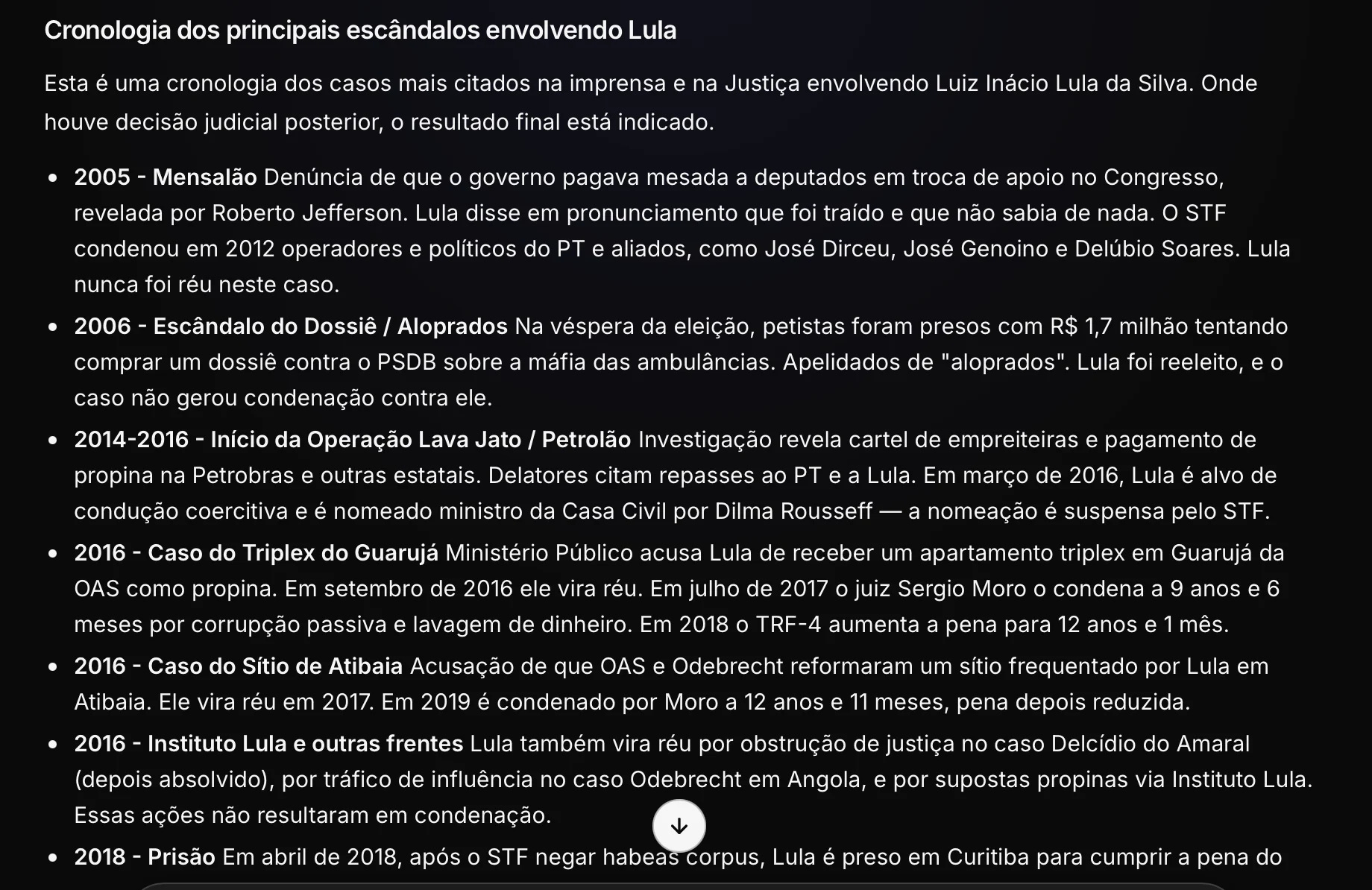
Although the prompt specifically asks for cases involving the president, the list includes the names of his allies and fellow party members. Only at the conclusion of the account does the AI response note that these cases did not directly involve the president.
According to an analysis by a monitoring firm, this type of format “can make various allegations appear as a consolidated report about Lula.”
This article was originally published by ICL Noticias. It was translated by Panamerican Dispatch. You can read the original, in Portuguese, here.