


By Ricardo Ribeiro Ferreira
The pattern repeated itself throughout the week. News coverage began treating investor confidence, spending restraint and the size of the fiscal adjustment as the key tests of the new term. Commitments made to voters showed up as obstacles to overcome, while the demands of business owners and financial players took on the weight of unavoidable economic necessities. The program chosen at the ballot box hardly mattered: the priority was once again to win the approval of “the market.” But who, exactly, is this omnipresent character, treated by the press as though it were a higher power to which even the president-elect must answer?
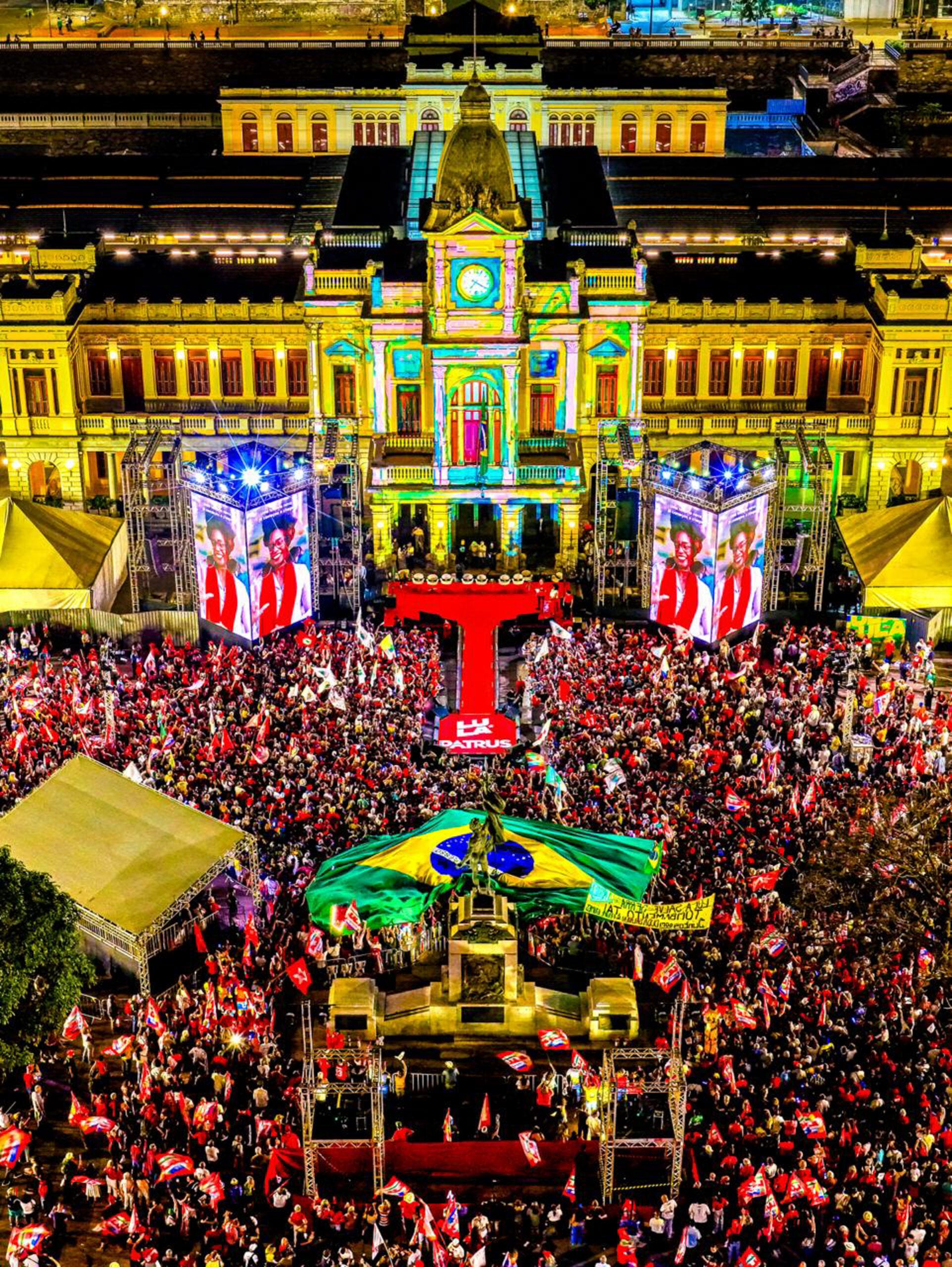
Brazil’s powerful mainstream media groups have spent decades threatening, extorting and pressuring the Workers Party to prioritize the billionaire class over the workers who brought it to power. (Photo: Ricardo Stuckert)
The “market” that stars in these headlines is not an abstract entity, much less a spokesperson for the Brazilian economy. It has a name, an address and well defined interests. On one side are bankers, large fund managers and speculators who move billions and get rich from high interest rates and financial deals, without producing equivalent wealth for the country. On the other are large business owners and conglomerates that demand cuts in social spending, tax breaks and other privileges to boost their profits. This is not about people who put part of their savings into the stock market to supplement their income, nor about small business owners who struggle to keep their companies afloat and rarely enjoy those advantages. It is the particular interests of these business and financial elites that the “mainstream press” presents as the needs of the whole country. Keeping these groups satisfied becomes a synonym for economic health, and their dissatisfaction a sign of coming disaster. What benefits them is called responsibility. What threatens their privileges becomes a risk, irresponsibility or crisis.
The private interests of an elite are raised to the status of the interests of all Brazilians, as if they were the public interest itself. Workers, retirees, small shopkeepers and millions of people who depend on public services are part of the economy too. Their needs, however, rarely get the same attention or authority on the economics pages and in TV newscasts. The problem is not listening to business owners and investors. It is turning their particular preferences into supposedly technical, universal criteria for setting the country’s course, even when those criteria go against the choices of the majority.
This is no accident. The large media groups are not just allies of the business and financial elites. Their owners belong to those same elites and hold specific economic interests that are rarely disclosed to the public. At the Folha Group, for example, Luiz Frias controls UOL and, through it, PagBank, the digital bank that grew out of PagSeguro. The Record Group and Edir Macedo control Banco Digi+, formerly Banco Renner. Globo, meanwhile, has a broad investment portfolio through Globo Ventures, including financial technology companies, and has set up its own structure to manage investments and funds abroad. The “mainstream press” is not merely the market’s spokesperson: its owners are also the market.
The alarmism around public debt is a prime example. Figures in the trillions make headlines as proof that Brazil is broke, as if the nominal size of the debt, on its own, showed it to be unsustainable. What also matters is its size relative to GDP, its trajectory and the cost of financing it. The same press that demands cuts to programs essential to the population and to national development, on the pretext of controlling the debt, defends high interest rates in the name of fighting inflation, often without discussing their economic and social costs. High rates make credit more expensive, hold back productive investment and raise the cost of the public debt itself. They also generously reward financial investments tied to the Selic, Brazil’s benchmark interest rate, which mainly benefits large holders of capital. Workers and small business owners bear the costs of this policy, but the gains of the rentier class are rarely held to the same scrutiny.
Even the choice of words reveals this logic. Social policies and public investment are reduced to mere “spending,” ignoring their effects on income, consumption and development. Economists who argue for growth through public investment, including as a way to reduce the weight of the debt relative to GDP, rarely get the same space. Measures essential to the population’s dignity have long been met with predictions of economic catastrophe. The abolition of slavery was opposed with arguments about the ruin of the economy. The anual 13th month bonus salary was announced as a disaster for the country. Today, the recent end of the 6 day work week is presented as a threat to growth. Meanwhile, labor and pension reforms enacted under the Temer and Bolsonaro administrations that took away rights from the working class drew wide support in the name of modernization and economic responsibility.
Several content analysis studies of the Brazilian press document this unequal treatment of economic and social policies. The agenda is not limited to editorials, where media companies openly defend their positions. It runs through the almost one note parade of analysts and commentators and reaches the economic news stories themselves. These narratives, in other words, are also built from decisions made in newsrooms every day.
In research based on in depth interviews with 40 journalists who worked at the Globo, Record and Folha groups, I examined how the interests of these companies’ owners and executives deeply shaped coverage of crucial events and contributed to a process of democratic deterioration in Brazil between 2016 and 2021. The accounts revealed a recurring pattern of favoring the neoliberal economic agenda in editorial decisions. One editor, for example, acknowledged that the newspaper where he worked criticized Jair Bolsonaro on many issues but largely shared his economic program. In another case, a journalist preparing a story about the candidates’ economic challenges in the 2018 election was told to interview experts who all had something in common: they all defended austerity. Readers would get a story that seemed grounded in technical opinion, but the economic alternatives had already been ruled out in the choice of sources.
Choosing sources was only one of the tactics for putting journalism to work for the owners’ interests that the research identified. Others included targeted selection of topics, imposed framings, selective editing, vetoes and even orders to produce certain stories. Some directives were presented as concerns about journalistic quality and balance, while others were direct orders from management. Over time, many professionals absorbed the company’s interests and began anticipating its preferences, with no one needing to give new orders. The point is not to condemn critical journalism or oversight of those in power, which are essential functions in a democracy, but to condemn their selective use to promote private interests. I call these journalistic practices that erode democracy: more than failing to protect democracy, journalism can directly help weaken it.
In the glass walled newsrooms of Brazil’s famous news organizations, the popular vote seems like an inconvenience to be tolerated, not a decision to be respected. Owners and top editors act as if they were better qualified than the voters themselves to set the country’s course, as if their mission were to lead a population they consider ignorant and unable to decide for itself. It is the arrogance of an elite that claims the role of tutor of democracy while defending its own privileges. Lula was not reelected to carry out the defeated candidate’s brutal budget cuts, but to implement a program of development, public investment and better living conditions for the population. He must not give in to blackmail. We have seen this story with Dilma Rousseff, and we know how it ended.
Ricardo Ribeiro Ferreira is a Leverhulme Fellow at the University of Liverpool. His research looks at the relationships among journalism, power and democracy, with a focus on media capture, the political use of journalism and forms of journalistic resistance. He holds a PhD in Politics from the University of Edinburgh and a master’s degree in Journalism and Communication from the University of Coimbra.
This article first appeared in LeMonde Diplomatique Brasil, has been translated with express authorization from its editor-in-chief by Panamerican Dispatch, and can be read in its original Portuguese here.