


by Ethel Rudnitzki
Agência Pública
During the 2026 election campaign, at least 1,069 advertisements mentioning incumbent President Luiz Inácio Lula da Silva or opponent Flávio Bolsonaro on Facebook, Instagram, and Threads were paid for in U.S. dollars. Data from Meta’s Ad Library analyzed by Agência Pública reveals that the ads cost at least $120,800.
The ads circulated without the political content label, which Meta’s rules require, between August 16 and September 30. After that, they were removed for violating platform policies. However, prior to removal, they had already garnered over 82 million impressions (the number of times an ad appears on a screen).
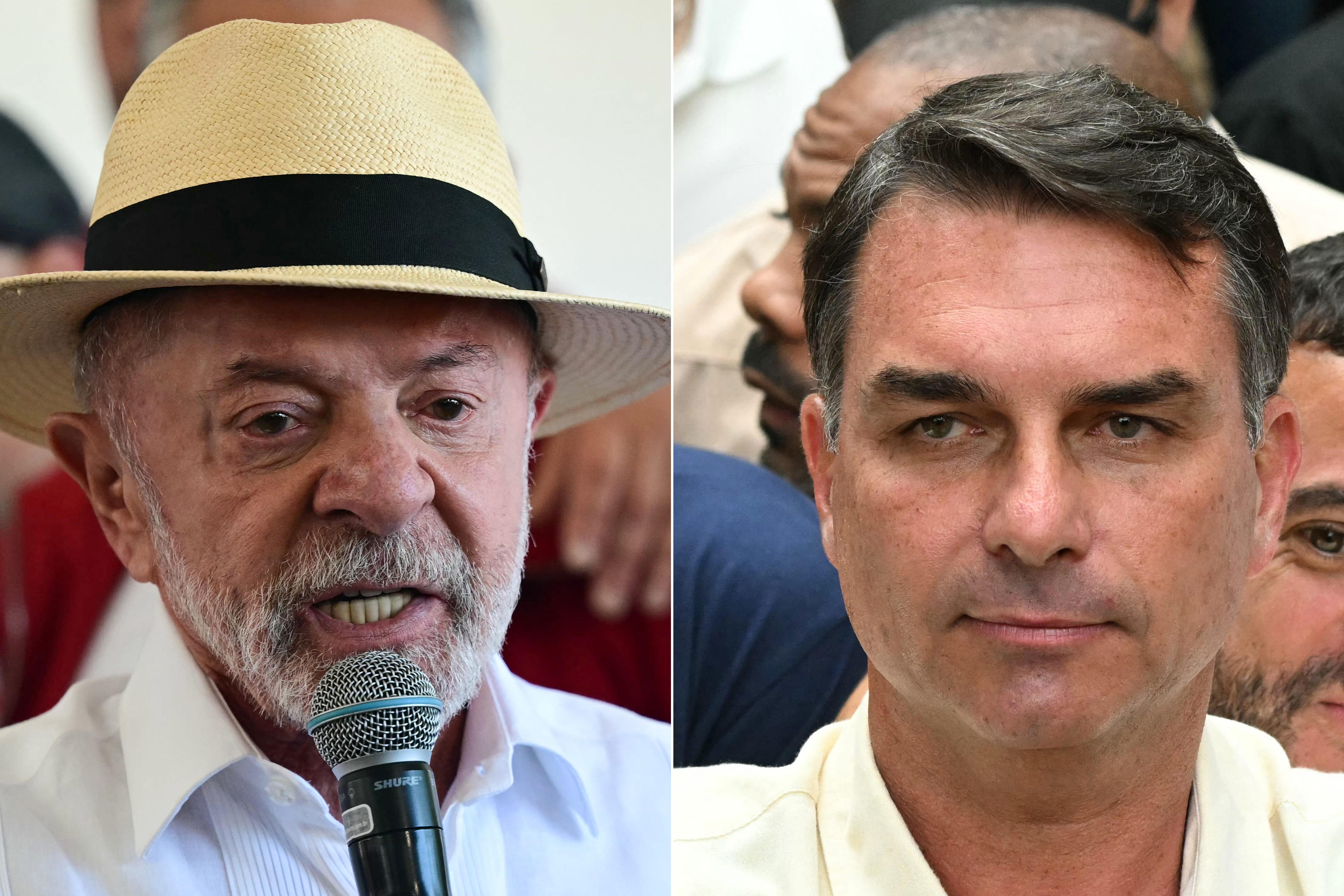
Incumbent President Luiz Inácio Lula da Silva of the Workers’ Party faces Flávio Bolsonaro of the Liberal Party in a run-off on October 25. (Photos by Pablo Porciuncula and Mauro Pimentel / AFP via Getty Images)
The political label mandates greater transparency regarding advertisers. If ads are not labeled as political, pages are not required to disclose who paid for them or the target audience for the content.
Promoted from Abroad
Some advertisers disclosed to Meta that the ads were paid for using a U.S.-based payment platform called pagolink.global, which is not available in Brazil. The company is headquartered in Delaware, a state that does not require the public disclosure of owners or stockholders. Through this platform, an ad campaign supporting presidential candidate Augusto Cury was promoted, as revealed by Agência Lupa. (In the first round election on October 4, Cury came in third place after Lula and Flávio Bolsonaro, and has since thrown his support behind Bolsonaro.)
Among the ads analyzed by Pública, PagoLink Global was responsible, for instance, for paying for an ad featuring a video containing misinformation about Lula. In the video, Congressman Nikolas Ferreira takes a statement by the president out of context to imply that he had insulted sanitation workers. The post ran on Meta’s social networks before being suspended, reaching more than 150,000 impressions.
PagoLink Global was also used to boost content opposing Flávio Bolsonaro. This included an ad linking to reporting by the news site ICL revealing that the candidate’s company shared an address with the office of Camilo Antunes, who is under investigation for social security fraud. The ad garnered over 70,000 impressions at a cost of $200.
According to election law attorney Vânia Aieta, merely using foreign platforms to pay for ads does not, in itself, constitute a violation, provided the expenditure is declared to the Electoral Court.
However, the ads violate electoral regulations prohibiting the boosting of content by third parties.
“Payment for boosting content is not permitted unless made by the candidate, their party or federation, or directly from the official campaign bank account. Since the campaign account must be denominated in Brazilian reais, payment in US dollars is also prohibited,” explains attorney Fernando Neisser.
Running ads containing negative campaigning against other candidates is also prohibited.
“Boosting content via an internet application provider may only be used to promote or benefit the candidacy, political party, or federation that contracted the service,” states electoral court Resolution No. 23.732/2024.
“Illegal boosting carries a penalty of 5,000 reais [approximately $1,000 dollars] or double the amount spent on that boosting, whichever is higher,” Neisser notes.
When asked, Meta stated that it had enforced its policies regarding the ads identified by Agencia Pública.
“Our ad review process involves multiple layers of screening and detection, both before and during delivery. The ads mentioned in the report were correctly identified by our systems for failing to include a label regarding social issues, elections, or politics, and our policies were applied to those ads,” states the note sent to Pública’s reporters.
This article originally ran at Agência Pública and was translated, with consent, by Panamerican Dispatch. It can be read in its original Portuguese, here.
BRAZIL: PT HELPS RIGHTIST VICTORY
The capitalist PT—like other self-described “leftists”—blames its defeats on imperialism.
No imperialist conspiracy is needed. The truth is obvious: the PT lost because it delivered no real changes for tens of millions of Brazilian workers and farmers. It insults us to portray workers as feeble-minded clay in the hands of imperialists and their all-powerful propaganda.
Leftists’ unfulfilled promises only fuel apathy and anger. Our lives grow harder, yet they insist our living conditions and wages improve and unemployment falls when they're in government. Such falsehoods conceal that capitalism was just as brutal under their rule as under the right.
Real wages are not rising beyond inflation, and unemployment is not falling. Official claims to the contrary are accounting tricks by bourgeois economists. In the United States, U-3, the official unemployment rate, stood at 4.2% in September; broader U-6 was 7.6%. U-3 excludes people who have not searched in four weeks. U-6 adds involuntary part-timers and some discouraged workers, but excludes people who stopped searching longer ago.
China’s official statistics count people as employed if they worked even one paid hour in the reference week. In June 2023, youth unemployment among 16-to-24-year-olds hit 21.3%. The government then suspended publication. When it resumed reporting in December 2023, it used a revised measure that excluded students, producing a lower figure.
The greatest gift to the right is the lie of “leftists” in power: “It’s not that bad.” We answer: “Don’t feed us that crap. We pay the bills and buy groceries.” The left sneers, “You’re just uneducated deplorables”—and the demagogic right cheers.
About 33 million Brazilians—mostly workers and farmers—abstained: 21% of the electorate in a country with mandatory voting. That was a damning verdict on the PT. In the 2024 U.S. election, close to 90 million Americans—roughly 36% of the voting-eligible population—did not vote. We have no workers’ parties to vote for.
LEFT DEFEAT FOLLOWS DEFEAT
The wretched FMLN’s brutal record, false promises, corruption, and secret gang deals helped bring Bukele to power. He promised to end crime and delivered a brutal crackdown on working people, while capitalist crime exploded. As brutal as his corrupt regime is, most prefer it to the Dantesque horrors of the maras under the FMLN.
In Argentina, corruption and the failures of the Peronist left helped open the way for Milei. In Colombia, the crimes of the FARC-ELN counterrevolutionaries, followed by the gap between Petro’s promises and results, led more workers and farmers to turn their backs on the left. So it went in Honduras, Ecuador, Chile, and elsewhere.
The reformist left paves the way for rightist demagogues. Workers are not embracing the right; we are turning our backs on the fake left and right. Workers and farmers have no parties or leadership of our own.
We saw the contradiction in Bolivia: a huge spontaneous mass movement nearly overthrew the government, yet it was a headless colossus without leadership—certainly not from the reformist MAS or pitiful Evo, hat in hand.
This is the real lesson of Brazil. The PT loyally serves Brazilian capitalists while tossing a few crumbs to workers, farmers, and Indigenous people. Despite its “caring” words and baby-kissing, its message to unemployed workers and landless peasants was: “Financial markets are doing great!” “Vote to make the rich richer!”
They repaid the PT in kind.
These defeats will continue until a genuine revolutionary left returns to our class and Marxism. None of today’s reformist left will do that. We workers and farmers must build our own movements, parties, and political program—or defeat will follow defeat, until even worse things come.