


by Elas por Elas
Women won the right to vote in Brazil 94 years ago, yet their place in political life is still under constant attack.
That is laid clear in a recent social media post by Paulo Figueiredo. He's a digital influencer, Bolsonaro family ally, and the grandson of Brazil’s last dictator, General João Figueiredo. He lives in the United States, and he wrote recently, “statistically, women vote very badly, especially single women. Married women, in general, tend to follow their husband’s vote.”
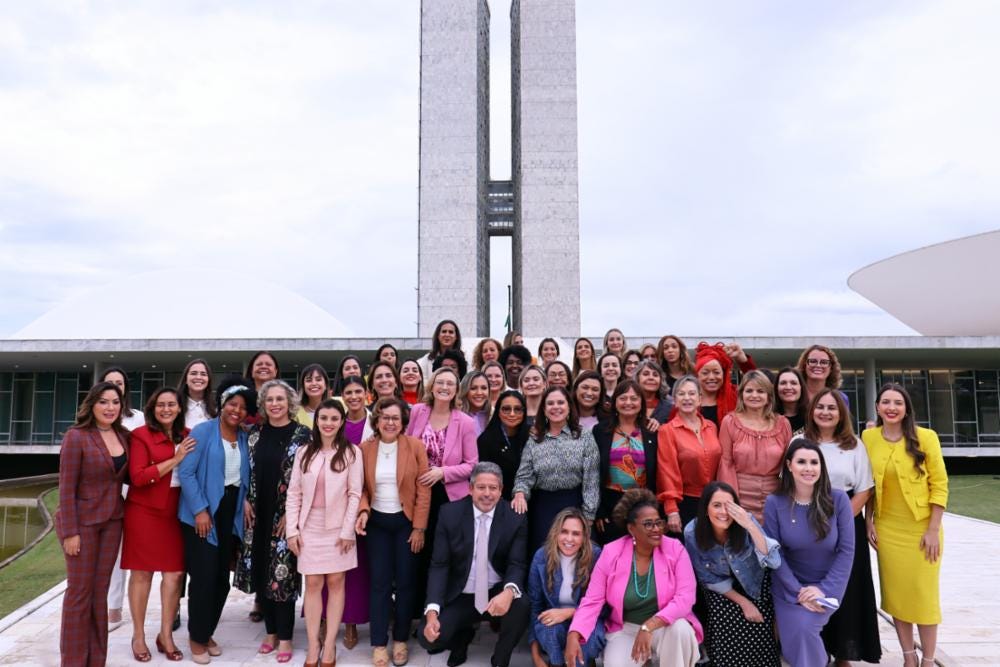
Women lawmakers in front of Brazil’s Congress building. Women make up 53% of the electorate, but only 91 of Brazil’s 513 Federal Deputies are women. (Marina Ramos/Ag. Câmara)
Remarks like these echo right-wing extremist views on women’s suffrage. They also show that discrimination against women is not isolated. It is part of a coordinated strategy to undermine their political rights.
Brazil’s Electoral Code recognized women’s right to vote in 1932. It was enshrined in the 1934 Constitution. Since then, women have steadily expanded their role in the country’s democracy. They now make up about 53% of voters, according to the Superior Electoral Court, and they can decide any national election. Still, they remain underrepresented in positions of power and they are the main victims of political violence because of their gender.
Women hold just 91 of the 513 seats in Congress, even though they account for more than half of the electorate. The Inequalities Notebook, a publication of the Inter-Parliamentary Union and UN Women, ranks Brazil 133rd in the world for women’s representation in congress, with the second-lowest rate on the list, ahead only of Japan.
The Senate shows the same pattern. Women are 53% of Brazil’s population, but the 16 women now serving as senators hold less than 20% of the 81 seats.
Until 2015, female senators had to leave parliament to use the women’s restroom in the restaurant next door. For more than 50 years, the Senate floor had only men’s restrooms, a sign of how long women were shut out of the space. That women kept showing up and pushed to change it is itself an important act of resistance.
Anyone who delegitimizes women’s votes attacks democracy
Figueiredo’s remark drew a formal response from Chamber of Deputies Representative Jackeline Rocha of the Workers’ Party, who represents the state of Espírito Santo and leads the Women’s Caucus in the Chamber of Deputies.
“Mr. Paulo Figueiredo,” she said, “your name belongs in the trash can of history. I want to raise a subject that is very dear to our democracy. Today I stand at this podium on behalf of the largest Women’s Caucus in the history of the Chamber of Deputies to say loud and clear that women’s vote is not up for debate. Women’s rights are not up for debate. Brazilian democracy cannot be called into question by Mr. Paulo Figueiredo saying that women don’t know how to vote. When someone says that, they insult not just millions of Brazilian women and men but almost a century of democratic struggle. They are trying to reopen a door that history has already closed.”
Brazil has taken several steps in recent years to expand women’s participation. Part of the Party Fund and the Special Campaign Financing Fund is now set aside for women and Black candidates. Law 14,192, from 2021 targets political violence against women. And Bill 896/2023, which would make misogyny a crime, is moving through Congress.
Mazé Morais, the Workers’ Party’s national secretary for women, said that defending women’s vote means defending democracy itself.
“When they say women don’t know how to vote, they aren’t just insulting half the population,” she said. “They are trying to delegitimize a historic achievement that took a great deal of struggle to win. Women know how to vote. We know how to govern. We know how to design public policy and change reality. What bothers some sectors is precisely our autonomy to decide the country’s direction.”
Elas por Elas is the communications sector of the Brazilian Workers’ Party’s Womens’ Secretariat.
This article was translated by Panamerican Dispatch and can be read in its original Portuguese here.
The views expressed in this article are those of the author and do not necessarily reflect the position of Panamerican Dispatch.